
As Amazon Associates, we earn from qualifying purchases. This means we may receive a small commission at no extra cost to you if you click through and make a purchase.
As an Amazon Associate we earn from qualifying purchases. Links on this page are affiliate links.
This viewsonic px701 4k UHD projector vs lsd500hd 1080p laser projector comparison highlights two DLP models built for different environments. Both units share DLP display technology and support ceiling mounting. The primary difference lies in their resolution and illumination. The PX701-4K delivers 4K UHD resolution with gaming features and HDR support. The LSD500HD provides a laser phosphor light source rated at 5,500 ANSI lumens with Full HD output for high ambient light.
Native Resolution
4K UHD (3840x2160p)
1080p (1920x1080p)
Brightness
3,200 ANSI lumens
5,500 ANSI lumens
Light Source
not listed
Laser phosphor (up to 30,000 hours)
Gaming Performance
240Hz refresh rate, 4.2ms input lag
not listed
HDR Support
HDR and HLG
not listed
Optical Zoom
1.1x
1.3x
Choose the first if
- You prioritize 4K UHD resolution and HDR support for home theater media or streaming.
- You require a 240Hz refresh rate and 4.2ms input lag for gaming responsiveness.
Choose the second if
- You need 5,500 ANSI lumens to maintain visibility in rooms with ambient light.
- You prefer a laser light source with up to 30,000 hours of operation and 360-degree mounting flexibility.
Verdict
Choose the ViewSonic PX701-4K if you want higher resolution, HDR compatibility, and low input lag for entertainment setups. Select the ViewSonic LSD500HD if you need significantly higher brightness and a maintenance-free laser light source for bright rooms or simulation setups.
ViewSonic PX701-4K vs LSD500HD Comparison
Brightness and light source
Edge: ViewSonic Full HD High-Lumen Laser DLP Projector
You get noticeably higher illumination from the ViewSonic LSD500HD, which delivers 5,500 ANSI lumens. That output helps you maintain clear visibility in brightly lit rooms and meeting spaces. It also relies on a laser phosphor light source rated for up to 30,000 hours, eliminating regular bulb replacements while offering instant power on and off. In contrast, the ViewSonic PX701-4K produces 3,200 ANSI lumens, which fits media rooms or gaming dens with ambient light. The PX701-4K specifications do not state a laser engine or light source lifespan. For raw output and long maintenance-free operation, the LSD500HD holds the clear lead.
Resolution and HDR format
Edge: ViewSonic 4K UHD Gaming Projector
If visual detail is your priority, the ViewSonic PX701-4K provides native 4K UHD resolution at 3840×2160 pixels. It also supports both HDR and HLG formats alongside SuperColor technology to deliver enhanced visual depth and wide color in movies or games. The ViewSonic LSD500HD caps its resolution at 1080p Full HD (1920×1080 pixels) and does not list HDR compatibility in its specifications. While 1080p delivers sharp visuals for presentations and simulation, the PX701-4K provides four times the pixel clarity. That higher resolution and high dynamic range support give the PX701-4K a significant edge for home entertainment.
Refresh rate and gaming response
Edge: ViewSonic 4K UHD Gaming Projector
The ViewSonic PX701-4K is built for fast interactive entertainment. You get a rapid 240Hz refresh rate paired with an ultra-low 4.2ms input lag, giving you responsive performance for competitive gaming where every millisecond counts. Meanwhile, the ViewSonic LSD500HD does not list a refresh rate or input latency figures in its documentation. Its design focuses on presentations in meeting rooms and golf simulation rather than high-speed video games. Because the PX701-4K provides published low-lag performance and a high refresh rate, you get smoother motion during fast gameplay compared to the business-focused LSD500HD.
Installation flexibility and optical zoom
Edge: ViewSonic Full HD High-Lumen Laser DLP Projector
For placement options, the ViewSonic LSD500HD provides greater installation versatility and optical adjustment. Its 1.3x optical zoom offers a wider range than the 1.1x optical zoom on the ViewSonic PX701-4K. The LSD500HD also features full 360-degree tilt and portrait mode support for creative signage or unusual room layouts. The PX701-4K does provide practical alignment tools, including auto-keystone, four-corner adjustment, and curved screen projection, casting a 100-inch image from 10.9 feet. However, the LSD500HD accommodates more varied physical angles thanks to its larger zoom range and complete 360-degree orientation support.
Physical build and connectivity
Edge: ViewSonic 4K UHD Gaming Projector
The ViewSonic PX701-4K offers a more compact weight and confirmed connectivity for your hardware. It weighs 6.2 pounds and measures 4.3 inches wide, 12.3 inches high, and 8.7 inches long. For streaming and consoles, it features dual HDMI inputs and a powered USB-A port to run streaming dongles. In comparison, the ViewSonic LSD500HD has a larger build measuring 15.8 inches wide, 5.1 inches high, and 11.3 inches long, with a heavier weight of 6.61 pounds. Its specific input ports are not listed in the provided data. The PX701-4K wins for everyday setup convenience.
Choosing the Right Projector for You
Competitive gamers needing responsive screen action
Our pick: ViewSonic 4K UHD Gaming Projector
You should choose this model if you play fast video games. It provides a 240Hz refresh rate alongside a 4.2ms input lag to keep inputs responsive. Dual HDMI ports let you connect modern gaming consoles directly, while the 4K resolution provides fine visual clarity across screen sizes reaching up to 150 inches.
Commercial setups needing flexible mounting angles
Our pick: ViewSonic Full HD High-Lumen Laser DLP Projector
You should pick this unit for creative display installations or golf simulation spaces. Its 360-degree tilt capability and portrait mode allow projection onto unusual surfaces. The 1.3x optical zoom offers positioning flexibility, and instant power cycling eliminates waiting times when starting up. The laser light source lasts up to 30,000 hours without maintenance.
Home cinema fans prioritizing color and streaming
Our pick: ViewSonic 4K UHD Gaming Projector
Select this unit if you want cinematic color depth in your home theater. HDR and HLG format support pairs with SuperColor technology to enhance high-dynamic-range content. It includes four-corner adjustment and curved screen projection support for specialized setups. Additionally, a built-in powered USB-A port supplies power directly to your streaming dongles.
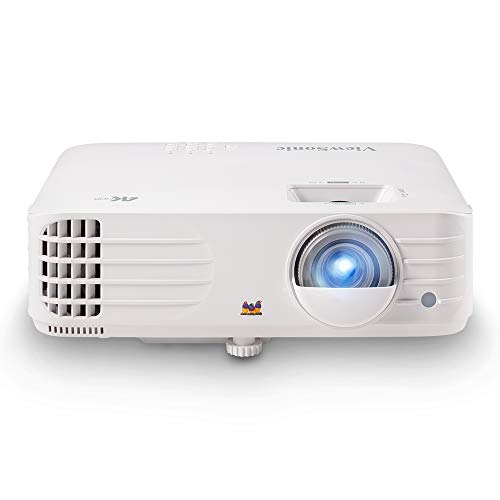
ViewSonic 4K UHD Gaming Projector
Best for: competitive gaming and 4K home theater setups
- Brightness
- 3,200 ANSI lumens
- Native Resolution
- 4K UHD
- Display Technology
- DLP
- HDR Format
- HDR, HLG
- Intended Use
- Gaming, Streaming
- Dimensions
- 8.7 × 4.3 × 12.3 inches
This DLP home theater projector delivers native 4K UHD resolution with 3,200 ANSI lumens of brightness. Designed for media rooms and gaming setups, it features a 240Hz refresh rate and a 4.2ms input lag for fast responsiveness. You get dual HDMI inputs, HDR and HLG decoding, and image sizes reaching up to 150 inches.
- Native 4K UHD 3840×2160 resolution
- 240Hz refresh rate with 4.2ms input lag
- 3,200 ANSI lumens with HDR and HLG support
- Auto-keystone and four-corner adjustment
- Optical zoom limited to 1.1x
- Maximum screen size capped at 150 inches
- Lower 3,200 ANSI lumen output than 5500-lumen models
- You prioritize 4K UHD resolution over standard 1080p projection.
- You play fast-paced games requiring a 240Hz refresh rate and 4.2ms lag.
- You want powered USB-A connectivity to run streaming dongles directly.
- You need higher output than 3,200 ANSI lumens for high ambient light spaces.
- You require an optical zoom range greater than 1.1x for placement flexibility.
Verdict: ViewSonic 4K UHD Gaming Projector fits console and PC players who require high-resolution 4K output paired with a 240Hz refresh rate. It delivers fast-response visuals for dedicated home theaters and light-controlled media spaces.

ViewSonic Full HD High-Lumen Laser DLP Projector
Best for: bright environments and flexible angled setups
- Brightness
- 5,500 ANSI lumens
- Native Resolution
- 1080p (1920x1080p)
- Light Source
- Laser phosphor
- Display Technology
- DLP
- Use
- Golf Simulation
- Mounting
- Ceiling Mount
This DLP projector pairs a laser phosphor light source with a 5,500 ANSI lumen output and native 1080p resolution. You get a 1.3x optical zoom and 360-degree mounting capability for angled installations. With its instant on-off power and 30,000-hour light source life, it suits you if you need high brightness in rooms with ambient light.
- 5,500 ANSI lumens of brightness for illuminated spaces
- Laser phosphor light source lasts up to 30,000 hours
- 360-degree tilt and portrait mode support
- 1.3x optical zoom for installation adjustment
- Native resolution tops out at 1080p rather than 4K
- Does not include high refresh rate or HDR specifications
- You need 5,500 ANSI lumens to overcome moderate ambient lighting in your space.
- You want a maintenance-free laser light source rated for up to 30,000 hours.
- You need 360-degree tilt or portrait orientation for specialized mounting angles.
- You want native 4K UHD resolution for high-detail video playback.
- You require high refresh rates or HDR support for fast-paced gaming.
Verdict: ViewSonic 5500-Lumen 1080p Laser Projector fits users who need powerful light output in illuminated rooms or require angled ceiling setups. It suits commercial spaces and simulator setups where high lumen output outweighs native 4K resolution.
Specifications side by side
| Spec | ViewSonic 4K UHD Gaming Projector | ViewSonic Full HD High-Lumen Laser DLP Projector |
|---|---|---|
| Brightness | 3,200 ANSI lumens | 5,500 ANSI lumens |
| Native Resolution | 4K UHD | 1080p (1920x1080p) |
| Light Source | – | Laser phosphor |
| Display Technology | DLP | DLP |
| HDR Format | HDR, HLG | – |
| Resolution | 4K UHD | 1080p Full HD |
| Intended Use | Gaming, Streaming | – |
| Use | Home Theater | Golf Simulation |
| Mounting | – | Ceiling Mount |
| Dimensions | 8.7 × 4.3 × 12.3 inches | 11.3 × 15.8 × 5.1 inches |
| Weight | 6.2 pounds | 6.61 pounds |
| Size | 4.3" x 12.3" x 8.7" | – |
| Color | Black | White |
| Model | PX701-4K | LSD500HD |
Frequently asked questions
What is the resolution difference between the ViewSonic PX701-4K and LSD500HD?
The ViewSonic PX701-4K provides 4K UHD resolution, while the LSD500HD delivers 1080p Full HD. You get quadrupled display pixels with the PX701-4K for sharper lines and enhanced image detail during streaming or media playback. The LSD500HD projects lower resolution imagery tailored for presentations and simulation setups.
Which projector is better suited for a golf simulation setup?
The ViewSonic LSD500HD is designed specifically for golf simulation setups. Its chassis supports ceiling mounting and projects high-lumen Full HD imagery to keep visual targets readable across simulator screens. In contrast, the PX701-4K suits you better for home theater viewing and media gaming in light-controlled spaces.
How do the size and weight of these two ViewSonic projectors compare?
The ViewSonic PX701-4K is smaller and lighter than the LSD500HD. The PX701-4K measures 4.3 by 12.3 by 8.7 inches and weighs 6.2 pounds. The LSD500HD measures 15.8 by 5.1 by 11.3 inches and weighs 6.61 pounds, meaning you require more mounting space for it.
Does the ViewSonic LSD500HD use a lamp or a laser light source?
The ViewSonic LSD500HD uses a solid-state laser light source rather than a conventional lamp. This laser engine provides stable illumination for bright spaces and commercial uses. In comparison, the PX701-4K lets you stream media and view home theater content with standard DLP projection technology.
What color finishes do the ViewSonic PX701-4K and LSD500HD come in?
The ViewSonic PX701-4K features a black casing, whereas the ViewSonic LSD500HD comes in a white finish. If you plan to mount your unit against a light ceiling or inside a bright room, the white finish of the LSD500HD blends in neatly with surrounding drywall surfaces.
Do both the PX701-4K and the LSD500HD use DLP display technology?
Both the PX701-4K and LSD500HD share DLP display technology. DLP imaging uses micro-mirrors to produce sharp picture elements and smooth motion tracking. While their native resolutions differ, both ViewSonic projectors rely on digital light processing to ensure you see crisp images across your selected projection surface.
See also
Prices and specifications above are read from the product page and can change without notice. Scores are out of 10, based on listed specifications and buyer feedback; nothing on this page comes from handling the product.


