
As Amazon Associates, we earn from qualifying purchases. This means we may receive a small commission at no extra cost to you if you click through and make a purchase.
As an Amazon Associate we earn from qualifying purchases. Links on this page are affiliate links.
This tcl 55 inch qm6k series vs 75 class q6lr series comparison examines two 4K displays with distinct panel technologies and operating systems. Both models deliver ultra-high-definition resolution and wide color support. The primary difference centers on screen size and motion performance. The 55-inch QM6K uses QD-Mini LED backlighting with a 144Hz refresh rate on Google TV, whereas the 75-inch Q6LR relies on QLED backlighting and Roku TV.
Screen size
55-Inch
75-Inch
Display technology
QD-Mini LED
QLED
Smart platform
Google TV
Roku TV
Refresh rate
144Hz
Not listed
HDR format
Dolby Vision, HDR10+, HDR10, HLG
HDR
Audio format
Dolby Atmos
Not listed
Choose the first if
- You want a 144Hz native refresh rate for gaming and fast-action motion.
- You prefer a QD-Mini LED display with Dolby Vision and Dolby Atmos support.
- You prefer the Google TV smart platform.
Choose the second if
- You want a larger 75-inch screen for a bigger viewing area.
- You prefer the Roku TV operating platform.
Verdict
Choose the 55-inch QM6K if you prioritize a 144Hz refresh rate, Mini-LED backlighting, and wide HDR format coverage. Select the 75-inch Q6LR if your focus is maximum screen area paired with Roku TV. Your choice depends on whether display technology or physical size matters more for your room.
TCL QM6K Versus TCL Q6LR Comparison
Screen size and dimensions
Edge: TCL 75-Inch QLED 4K Roku TV
Screen size directly shapes how immersive your viewing experience feels. The TCL 75-Inch QLED 4K Roku TV provides a 75-inch diagonal screen, measuring 65.6 inches wide, 40.7 inches high, and 13.7 inches deep with a weight of 51.1 pounds. In contrast, the TCL 55-Inch Mini-LED 144Hz Google TV carries a 55-inch display. Its cabinet measures 48.4 inches wide, 30.5 inches high, and 11.6 inches deep, weighing 27.3 pounds. The 75-inch panel on the Q6LR gives you substantially more display surface area for larger living rooms, while the 55-inch QM6K fits tighter spaces and smaller media consoles.
Display panel technology
Edge: TCL 55-Inch Mini-LED 144Hz Google TV
Backlight structure determines contrast performance and brightness precision across various lighting conditions. The TCL 55-Inch Mini-LED 144Hz Google TV uses QD-Mini LED technology paired with the TCL Halo Control System. This design combines quantum dots with mini-LED backlights and local dimming zones to suppress blooming and improve dark scene accuracy. The TCL 75-Inch QLED 4K Roku TV features standard QLED architecture with a High Brightness+ LED backlight. While both models utilize quantum dot color layers, the QM6K includes mini-LED diodes and dedicated local dimming, allowing it to control illumination more precisely than the standard LED backlight inside the Q6LR.
Refresh rate and motion
Edge: TCL 55-Inch Mini-LED 144Hz Google TV
Panel speed dictates how cleanly fast motion renders during sports or gaming sessions. The TCL 55-Inch Mini-LED 144Hz Google TV lists a native 144Hz refresh rate alongside Motion Rate 480 processing. A 144Hz refresh rate updates the picture up to 144 times every second, which minimizes visual blur during rapid camera pans and high-frame-rate gameplay. For the TCL 75-Inch QLED 4K Roku TV, the published specifications highlight Game Accelerator technology but do not state a native panel refresh rate or motion index. Because the QM6K explicitly provides a verified 144Hz native refresh rate, it offers superior motion clarity for action scenes.
HDR format support
Edge: TCL 55-Inch Mini-LED 144Hz Google TV
High dynamic range processing expands brightness ranges and fine shadow gradations in compatible video streams. The TCL 55-Inch Mini-LED 144Hz Google TV supports four separate formats: Dolby Vision, HDR10+, standard HDR10, and HLG. Both Dolby Vision and HDR10+ utilize dynamic metadata, adjusting brightness scene by scene or frame by frame according to content instructions. The TCL 75-Inch QLED 4K Roku TV lists standard HDR support in its specifications, without citing dynamic formats such as Dolby Vision or HDR10+. With full compatibility across major dynamic profiles, the QM6K adapts to a wider selection of mastering standards.
Smart TV platform
Edge: Tie
Smart platforms dictate content organization, navigation, and system menus. The TCL 55-Inch Mini-LED 144Hz Google TV runs on Google TV, which aggregates streaming recommendations across services directly on the primary home screen. The TCL 75-Inch QLED 4K Roku TV operates on Roku TV, providing an app-centric grid interface focused on straightforward channel selection and input switching. Both operating systems deliver broad access to popular streaming applications and network services. Your preference between Google TV and Roku TV comes down to interface design, as neither platform offers an inherent technical advantage over the other for daily streaming.
Choosing Your Ideal TCL Television
Gamers seeking fast motion and high frame rates
Our pick: TCL 55-Inch Mini-LED 144Hz Google TV
You should choose this model for its native 144Hz refresh rate and Motion Rate 480 processing. These specs deliver clear action for fast-paced video games and live sports. The QD-Mini LED screen provides local dimming via the Halo Control System, while Google TV and Dolby Atmos audio support your gaming setups.
Shoppers prioritizing screen size for larger rooms
Our pick: TCL 75-Inch QLED 4K Roku TV
You should select this television if you want expansive display area. Its 75-inch screen measures 65.6 inches wide and 40.7 inches tall, giving you substantial coverage for big spaces. It combines 4K UltraHD resolution with a QLED panel and the Roku TV smart platform to deliver direct navigation for streaming.
Home theater fans focused on HDR format variety
Our pick: TCL 55-Inch Mini-LED 144Hz Google TV
You will benefit from this display if you watch diverse HDR media. It supports Dolby Vision, HDR10+, HDR10, and HLG formats to match various video sources. The 55-inch QD-Mini LED screen enhances contrast with precise local dimming, while integrated Dolby Atmos sound delivers advanced audio decoding for movies.
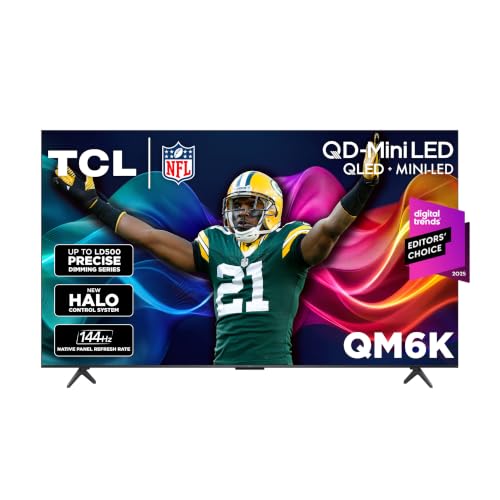
TCL 55-Inch Mini-LED 144Hz Google TV
Best for: High-refresh gaming and HDR viewing in midsize rooms
- Screen Size
- 55-Inch
- Resolution
- 4K
- Display Technology
- QD-Mini LED, QLED
- Refresh Rate
- 144Hz
- HDR Format
- Dolby Vision, HDR10+, HDR10, HLG
- Smart Platform
- Google TV
You get a 55-inch 4K screen powered by QD-Mini LED backlighting and a native 144Hz refresh rate. It runs Google TV and supports Dolby Vision, HDR10+, HDR10, HLG, and Dolby Atmos audio. With local dimming via the Halo Control System, it suits you if you want high frame rates and precise contrast in a midsize room.
- Native 144Hz refresh rate with Motion Rate 480
- QD-Mini LED backlighting with Halo Control local dimming
- Wide HDR support: Dolby Vision, HDR10+, HDR10, and HLG
- Built-in Google TV platform and Dolby Atmos audio
- Smaller 55-inch screen size compared to 75-inch options
- Stand base requires 11.6 inches of depth
- You need a native 144Hz panel for high-frame-rate gaming and fast sports.
- You want Mini-LED backlighting with local dimming for contrast control.
- You prefer Google TV as your smart streaming platform.
- You want a large 75-inch display for a large room.
- You prefer the Roku TV operating system.
Verdict: TCL 55-Inch QM6K QD-Mini LED 144Hz TV delivers fast 144Hz motion and Mini-LED local dimming in a compact size. It fits gamers and movie watchers who value picture precision and high refresh rates over maximum screen area.

TCL 75-Inch QLED 4K Roku TV
Best for: big-room viewing with simple Roku streaming
- Screen Size
- 75-Inch
- Resolution
- 4K UltraHD
- Display Technology
- QLED
- HDR Format
- HDR
- Smart Platform
- Roku TV
- Dimensions
- 13.7 × 65.6 × 40.7 inches
This television gives you a 75-inch QLED display with native 4K UltraHD resolution. It runs the built-in Roku TV smart platform, offering direct access to streaming channels without extra boxes. The panel pairs quantum dots with an LED backlight for standard HDR playback. This display suits you if you prioritize massive screen area in a spacious living room.
- Large 75-inch panel provides broad viewing area
- 4K UltraHD resolution with QLED color technology
- Built-in Roku TV platform for streaming
- Includes Game Accelerator mode
- Standard LED backlight lacks Mini LED backlighting
- Broad 65.6-inch width and 51.1-pound weight require substantial mounting support
- You want a large 75-inch screen for a wide seating area.
- You prefer the Roku TV operating system for menu navigation.
- You want quantum dot color enhancement on a standard LED panel.
- You prefer Mini LED backlighting for localized contrast control.
- You have limited entertainment center width for a 65.6-inch cabinet.
Verdict: TCL 75-Inch QLED 4K Roku TV delivers substantial screen dimensions and simple Roku menu controls. It suits buyers seeking a large living-room display who do not require Mini LED backlighting.
Specifications side by side
| Spec | TCL 55-Inch Mini-LED 144Hz Google TV | TCL 75-Inch QLED 4K Roku TV |
|---|---|---|
| Screen Size | 55-Inch | 75-Inch |
| Resolution | 4K | 4K UltraHD |
| Display Technology | QD-Mini LED, QLED | QLED |
| Refresh Rate | 144Hz | – |
| HDR Format | Dolby Vision, HDR10+, HDR10, HLG | HDR |
| Smart Platform | Google TV | Roku TV |
| Audio Format | Dolby Atmos | – |
| Intended Use | Gaming | – |
| Size | 55-Inch | 75-Inch |
| Dimensions | 11.6 × 48.4 × 30.5 inches | 13.7 × 65.6 × 40.7 inches |
| Weight | 27.3 pounds | 51.1 pounds |
| Color | Black | Black |
| Model | 55QM6K | – |
Frequently asked questions
Which smart TV platform does each model run?
The TCL 55QM6K runs Google TV, while the 75-inch Q6LR model runs the Roku TV platform. Google TV integrates with Google services and smart home setups. Roku TV provides a distinct interface built around channels and streaming applications. You choose based on your preferred interface and ecosystem.
Does the 55-inch QM6K or the 75-inch model offer a higher refresh rate?
The TCL 55QM6K features a native 144Hz refresh rate, whereas the 75-inch Q6LR specifications do not list a high-refresh panel. A 144Hz display updates the image 144 times per second. This spec helps you achieve smooth motion and low input lag when connecting modern gaming consoles or PC hardware.
How does the backlighting differ between the QM6K and the 75-inch Q6LR?
The 55-inch QM6K uses Mini-LED backlighting, while the 75-inch display uses standard LED backlighting with QLED color technology. Mini-LED utilizes smaller diodes behind the screen to allow precise control over dark and bright areas. The 75-inch QLED design relies on quantum dots for color over conventional LED lights.
Which HDR formats are supported on the TCL 55-inch QM6K?
The TCL 55-inch QM6K explicitly supports Dolby Vision and HDR10 formats. High dynamic range expands contrast and color depth in compatible movies and video games. The published specifications for the 75-inch Q6LR do not list specific HDR format support, making the 55-inch unit the defined choice for Dolby Vision playback.
What are the physical dimensions and weight differences between these two TVs?
The 55-inch QM6K measures 48.4 inches wide by 30.5 inches high and weighs 27.3 pounds. The 75-inch Q6LR measures 65.6 inches wide by 40.7 inches high and weighs 51.1 pounds. You need substantially more wall space or a much wider media console to safely accommodate the larger 75-inch unit.
Does either television support Dolby Atmos audio decoding?
The TCL 55-inch QM6K lists built-in Dolby Atmos audio support, while the 75-inch Q6LR does not include Atmos in its specifications. Dolby Atmos provides spatial sound processing when you connect compatible soundbars or speaker setups. This feature helps create a more immersive surround experience in your entertainment space.
Are both the TCL QM6K and the 75-inch Q6LR native 4K displays?
Both televisions deliver native 4K UHD resolution, which equals 3840 by 2160 pixels. Because the 55-inch QM6K fits those pixels into a smaller surface area, it offers higher pixel density than the 75-inch model. The 75-inch screen spreads the same resolution across a wider viewing area for greater immersion.
See also
Prices and specifications above are read from the product page and can change without notice. Scores are out of 10, based on listed specifications and buyer feedback; nothing on this page comes from handling the product.


