As Amazon Associates, we earn from qualifying purchases. This means we may receive a small commission at no extra cost to you if you click through and make a purchase.
As an Amazon Associate we earn from qualifying purchases. Links on this page are affiliate links.
You are comparing the tcl 55 inch qm6k series vs 65 inch r7d series QLED to decide which fits your space and habits. Both are 4K QLED smart TVs from TCL. They share high brightness and strong motion handling for sports and gaming. The main difference is size and platform. The QM6K is a 55-inch Mini-LED model running Google TV. The R7D is a larger 65-inch QLED model using Roku TV. Your choice depends on screen size preference and interface style.
Screen Size
55-Inch
65 inch
Display Technology
QD-Mini LED
QLED
Smart Platform
Google TV
Roku TV
Refresh Rate
144Hz
Motion Rate 240
HDR Format
Dolby Vision, HDR10+, HDR10, HLG
Open HDR, HDR10, HDR10+, HLG
Audio Format
Dolby Atmos
Dolby Digital+
Choose the first if
- You prefer a smaller 55-inch screen for tighter spaces.
- You want the deeper contrast and higher peak brightness of Mini-LED technology.
- You favor the Google TV interface and Dolby Atmos audio support.
Choose the second if
- You want a larger 65-inch display for a living room or media room.
- You prefer the simplicity and channel-focused layout of Roku TV.
- You value AirPlay 2 compatibility and smart home integration with Apple HomeKit.
Verdict
Choose the QM6K if you prioritize Mini-LED contrast and Google TV. Choose the R7D if you need a larger screen and prefer the Roku interface. Both deliver solid 4K performance for streaming and gaming.
QM6K vs R7D Spec Comparison
Display technology
Edge: TCL 55-Inch Mini-LED 144Hz Google TV
The TCL 55-Inch Mini-LED 144Hz Google TV uses QD-Mini LED technology. This combines Mini LEDs with Quantum Dot color for high brightness and deep contrast. The TCL 65-Inch QLED Roku TV uses standard QLED. It offers rich color but lacks the precise local dimming of Mini LED. The QM6K’s Halo Control System further refines shadow detail and reduces blooming. This makes the Mini LED panel superior for dark room viewing. You get better black levels and sharper highlights with the QM6K. The R7D is a solid QLED but does not match the advanced backlighting of the QM6K.
Smart platform
Edge: Tie
The QM6K runs Google TV. This platform offers a unified content stream and extensive app support. The R7D uses Roku TV. Roku is known for its simple, clutter-free interface and fast performance. Both platforms support major streaming services. Google TV may feel more feature-rich for power users who want search depth. Roku is often preferred for its straightforward navigation and ease of use. If you prefer a minimalist home screen, the R7D is ideal. If you want advanced search and integration, the QM6K is better. Your choice depends on your preferred ecosystem.
Refresh rate
Edge: TCL 55-Inch Mini-LED 144Hz Google TV
The QM6K features a 144Hz native refresh rate with a Motion Rate of 480. This provides ultra-smooth motion for fast-paced sports and next-gen gaming. The R7D has a Motion Rate of 240. While this is good for general viewing, it does not match the 144Hz panel of the QM6K. The higher refresh rate on the QM6K reduces motion blur more effectively. Gamers will benefit from the smoother frame delivery on the QM6K. The R7D is sufficient for most content, but the QM6K offers superior motion clarity for high-frame-rate sources.
HDR format
Edge: TCL 55-Inch Mini-LED 144Hz Google TV
The QM6K supports Dolby Vision, HDR10+, HDR10, and HLG. This covers almost all major HDR standards. The R7D supports Open HDR, HDR10, HDR10+, and HLG. It lacks Dolby Vision support. Dolby Vision offers dynamic metadata for scene-by-scene optimization. This results in better contrast and color accuracy on compatible content. The QM6K provides a more comprehensive HDR experience. You will see the difference when streaming Dolby Vision titles. The R7D handles standard HDR well, but the QM6K is more versatile.
Audio format
Edge: TCL 55-Inch Mini-LED 144Hz Google TV
The QM6K supports Dolby Atmos audio. This provides immersive, object-based sound for movies and games. The R7D supports Dolby Digital+. This is a standard surround format but lacks the height channels of Atmos. Dolby Atmos creates a more three-dimensional soundstage. If you plan to use the TV speakers, the QM6K offers better audio fidelity. Both TVs benefit from external soundbars. However, the QM6K’s audio decoding is more advanced. You get richer sound details with the QM6K.
Screen size
Edge: TCL 65-Inch QLED Roku TV
The QM6K is a 55-inch model. The R7D is a 65-inch model. The R7D offers a significantly larger viewing area. This is ideal for larger living rooms or closer seating distances. The QM6K is better for smaller spaces or where wall space is limited. The 10-inch difference is substantial for immersion. If you want a big screen presence, the R7D is the clear choice. If you need a compact fit, the QM6K is better. Size is a physical constraint, not a quality metric.
Which TCL TV fits your needs
You want the largest screen for movies
Our pick: TCL 65-Inch QLED Roku TV
The 65-inch R7D provides a bigger viewing area for your living room or media space. Its 65-inch panel size makes it ideal for open-concept rooms where you want a main screen anchor. The Roku platform keeps streaming simple without extra boxes. This larger footprint suits those prioritizing screen real estate over other features.
You need high refresh rate for gaming
Our pick: TCL 55-Inch Mini-LED 144Hz Google TV
The 55-inch QM6K offers a 144Hz native refresh rate, which is superior for fast-paced gaming and sports. Its QD-Mini LED technology delivers higher brightness and better contrast than the standard QLED panel. Google TV provides access to a wide range of apps. This model is better for gamers who value smooth motion and accurate HDR.
You prefer Roku for easy streaming
Our pick: TCL 65-Inch QLED Roku TV
The R7D runs on the Roku TV platform, which simplifies navigation with a single home screen. It supports AirPlay 2 and Google Cast for easy mirroring. The interface is straightforward for accessing live news and streaming channels. If you want a hassle-free smart experience without a complex menu system, this 65-inch model is the practical choice.
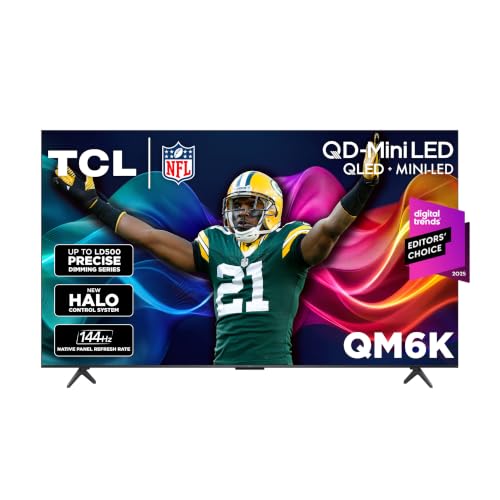
TCL 55-Inch Mini-LED 144Hz Google TV
Best for: Gaming and sports on a 55-inch screen
- Screen Size
- 55-Inch
- Resolution
- 4K
- Display Technology
- QD-Mini LED, QLED
- Refresh Rate
- 144Hz
- HDR Format
- Dolby Vision, HDR10+, HDR10, HLG
- Smart Platform
- Google TV
The TCL 55-Inch QM6K Series uses QD-Mini LED technology to deliver high brightness and contrast. It features a 144Hz native refresh rate and Google TV. This 55-inch model weighs 27.3 pounds. It supports Dolby Vision and HDR10+. You get a smooth viewing experience for sports and gaming. The display handles fast motion with minimal blur. It is a practical option for those who want premium specs in a compact size.
- QD-Mini LED display for high brightness
- 144Hz native refresh rate for smooth motion
- Google TV smart platform
- Dolby Vision and HDR10+ support
- 55-inch screen is smaller than the 65-inch option
- 27.3-pound weight adds bulk compared to lighter models
- 11.6-inch depth requires more space behind the TV
- You want a high refresh rate for gaming
- You prefer Google TV over Roku
- You need a smaller 55-inch footprint
- You require a 65-inch screen size
- You prefer the Roku interface
- You need a lighter or thinner wall mount
Verdict: TCL 55-Inch QM6K QD-Mini LED suits gamers and sports fans who want a 144Hz panel in a compact 55-inch frame. It delivers strong brightness and color accuracy for its size.

TCL 65-Inch QLED Roku TV
Best for: Living room entertainment and sports
- Screen Size
- 65 inch
- Resolution
- 4K UHD (3840×2160)
- HDR Format
- Open HDR, HDR10, HDR10+, HLG
- Smart Platform
- Roku TV
- Audio Format
- Dolby Digital+ passthrough
- Intended Use
- Streaming, Sports
This 65-inch QLED TV delivers 4K UHD resolution with Open HDR, HDR10, HDR10+, and HLG support for sharper detail and richer contrast. It features Motion Rate 240 with MEMC to smooth fast motion, making it suitable for sports and gaming. The built-in Roku TV platform provides access to streaming channels without a separate box. It connects via three HDMI inputs, including ARC/eARC, and supports Dolby Digital+ audio.
- QLED display technology for vibrant color
- Motion Rate 240 with MEMC for smooth motion
- Roku TV smart platform for easy streaming
- Game Accelerator 120 and Auto Low Latency Mode
- Three HDMI inputs including ARC/eARC
- Heavier build at 40.8 pounds
- Larger footprint with a width of 56.9 inches
- Standard QLED without Mini LED backlighting
- You want a large screen for living room viewing
- You prefer the simplicity of the Roku interface
- You watch live sports and need smooth motion
- You need Mini LED brightness for dark rooms
- You prefer a Google TV interface
- You have limited wall space for a 65-inch unit
Verdict: TCL 65-Inch R7D QLED Roku TV is a solid choice for viewers who prioritize screen size and motion clarity over peak brightness. It fits well in living rooms where a large, straightforward smart TV is the main focus.
Specifications side by side
| Spec | TCL 55-Inch Mini-LED 144Hz Google TV | TCL 65-Inch QLED Roku TV |
|---|---|---|
| Screen Size | 55-Inch | 65 inch |
| Resolution | 4K | 4K UHD (3840×2160) |
| Display Technology | QD-Mini LED, QLED | – |
| Refresh Rate | 144Hz | – |
| HDR Format | Dolby Vision, HDR10+, HDR10, HLG | Open HDR, HDR10, HDR10+, HLG |
| Smart Platform | Google TV | Roku TV |
| Audio Format | Dolby Atmos | Dolby Digital+ passthrough |
| Intended Use | Gaming | Streaming, Sports |
| Size | 55-Inch | 65-Inch |
| Dimensions | 11.6 × 48.4 × 30.5 inches | 11.8 × 56.9 × 34.6 inches |
| Weight | 27.3 pounds | 40.8 pounds |
| Color | Black | – |
| Model | 55QM6K | 65R7D |
Frequently asked questions
Which TCL TV is better for gaming?
The TCL 55-Inch QM6K is the better choice for gaming. It features a 144Hz refresh rate, which ensures smoother motion for fast-paced games. It also supports Dolby Atmos audio for immersive sound. The R7D does not list a high refresh rate, making the QM6K superior for competitive play.
Does the 55-inch QM6K support Google TV?
Yes, the 55-inch QM6K runs on the Google TV smart platform. This gives you access to a wide range of apps and a unified search interface. The 65-inch R7D uses Roku TV instead, which offers a different streaming experience with its own app store and interface layout.
What is the difference in display technology between these models?
The QM6K uses QD-Mini LED technology, which combines Quantum Dots with Mini LEDs for higher brightness and contrast. The R7D uses standard QLED technology. Both deliver rich colors, but the Mini-LED backlighting in the QM6K typically allows for more precise local dimming and deeper blacks compared to standard QLED.
Is the 65-inch R7D suitable for watching sports?
Yes, the 65-inch R7D is well-suited for sports. Its larger 65-inch screen provides an immersive viewing experience for live events. The QLED panel offers strong color reproduction and good motion clarity. It is ideal if you prioritize screen size and a straightforward smart interface for streaming sports content.
Which TV supports Dolby Vision HDR?
The TCL 55-Inch QM6K supports Dolby Vision HDR. It also handles HDR10 for compatible content. The specifications for the 65-inch R7D do not list specific HDR formats. If Dolby Vision compatibility is a priority for your media library, the QM6K is the clear option between the two.
How much space does each TV take up?
The 55-inch QM6K measures 48.4 inches wide and weighs 27.3 pounds. The 65-inch R7D is larger at 56.9 inches wide and weighs 40.8 pounds. If you have limited wall or stand space, the 55-inch model is more compact. The 65-inch model requires a significantly larger footprint.
See also
Prices and specifications above are read from the product page and can change without notice. Scores are out of 10, based on listed specifications and buyer feedback; nothing on this page comes from handling the product.