
As Amazon Associates, we earn from qualifying purchases. This means we may receive a small commission at no extra cost to you if you click through and make a purchase.
As an Amazon Associate we earn from qualifying purchases. Links on this page are affiliate links.
This projector screen buying guide helps you select the right display surface for your room setup. By reading it, you will be able to decide between fixed frame, manual pull-down, and motorized units. The guide walks you through essential choices, such as screen size, aspect ratio, throw distance support, and mounting method. Understanding these technical details prevents setup errors and ensures clean alignment with your projector.
To help you compare options, the list below features 8 picks for 2026, selected strictly from their published specifications. You will see how verified dimensions, tensioning features, resolution compatibility, and housing weights differ across models. Matching your room layout directly to these published manufacturer measurements allows you to pick a reliable screen that suits your specific viewing space and hardware.
Key Projector Screen Specifications to Compare
Screen Mounting Style
Screen housing determines permanent placement and storage flexibility. Fixed frame models mount directly to a wall, maintaining constant surface tension for dedicated home theaters. Manual pull-down screens and motorized screens retract inside a housing case, saving space in multi-use rooms. A motorized unit lowers via an integrated motor or remote switch, removing the physical effort of manual retraction. Portable screens use freestanding legs or reinforced hanging grommets for temporary indoor or outdoor setups. If you choose a motorized housing like the Akia Screens 150-Inch Motorized Projector Screen, you need a nearby power connection and ceiling or wall anchors. Retractable rollers save wall space, but fixed frames eliminate mechanical roller parts entirely.
Look for
- Fixed frame builds for dedicated home cinema rooms
- Retractable motorized or manual cases for multi-purpose spaces
- Freestanding or grommeted frames for outdoor gatherings
Native Aspect Ratio
Aspect ratio defines the proportional relationship between the width and height of the display area. A 16:9 ratio matches modern cinema movies, television broadcasts, streaming feeds, and video gaming consoles. Selecting a 16:9 surface avoids extensive horizontal letterboxing bars when viewing widescreen media. A 4:3 ratio suits retro gaming systems, older television broadcasts, and standard office presentation slides. If you display modern entertainment on a 4:3 screen, empty black space appears along the top and bottom. The Elite Screens Spectrum 180-Inch 4:3 Motorized Screen illustrates a specialized 4:3 format for classic presentations. Matching the screen geometry to your projector's native output avoids image cropping and unused border space.
Look for
- 16:9 aspect ratios for modern films, streaming, and gaming
- 4:3 formats for classic media and presentation slideshows
Projector Throw Compatibility
The distance between the lens and the projection surface determines throw geometry. Standard-throw projectors cast light from several feet away across the room. Ultra-short-throw projectors sit directly beneath or in front of the screen, projecting upward at an extreme vertical angle. Standard projector screens can develop slight surface ripples that distort ultra-short-throw beams into wavy artifacts. Dedicated materials, such as the surface on the Elite Screens Aeon 180-inch Fixed Frame Screen, support both standard-throw and ultra-short-throw systems without geometrical distortion. Confirm your projector lens specifications before picking a screen, because choosing an incompatible standard pull-down roller for an ultra-short-throw projector produces uneven visual lines and degraded focus across the display.
Look for
- Ultra-short-throw support if placing projectors close beneath the display
- Standard-throw compatibility for long-distance ceiling or rear shelf mounts
Surface Material and Gain
Screen material determines color accuracy, ambient light handling, and reflective efficiency. Gain measures light reflection compared to a standard reference whiteboard. A standard matte white material disperses light evenly across wide viewing angles, making off-axis viewing clear. Higher gain materials, such as the 1.3 gain surface on the Elite Screens 300-Inch Hanging Outdoor Screen, reflect more light toward centered seats to boost overall image brightness in dimly lit areas. Specialized materials like Grey Crystal improve contrast by absorbing ambient reflections in brighter environments. However, higher gain coatings can narrow the viewing cone, creating hot spots in the center. Select matte surfaces for wide seating arrangements and higher gain surfaces for dimmer environments.
Look for
- Matte white surfaces for wide off-axis viewing angles
- High-gain fabrics for boosting brightness in large outdoor venues
- Grey contrast surfaces for rooms with ambient room light
Surface Flatness and Tensioning
Flatness prevents geometry distortion and optical distortion across the frame. Fixed frame screens use spring or rod tensioning systems along the perimeter to stretch the material completely rigid and flat. Standard manual and motorized roller screens hang freely under the weight of a bottom bar, which can allow subtle surface curling along the edges over time. Tab-tensioned roller systems use side cords to pull retractable material flat across the horizontal plane. The MIGO 100-Inch Tab-Tensioned Motorized Screen uses tab tensioning to combine flat projection with retractable storage. Non-tensioned roll-up screens cost less space-wise and mechanically, but tab-tensioned or fixed systems guarantee uniform focus across high-resolution video streams.
Look for
- Tab-tensioned side cables on motorized roll-up units
- Rigid border spring tensioning on fixed wall screens
Surface Resolution Compatibility
Screen resolution ratings specify how finely the projection fabric is woven or coated. Projectors outputting 4K UHD or 8K signals project dense pixel grids that require smooth, non-grainy surfaces. Coarse textures or heavy grain patterns create optical moire interference and obscure fine line detail in high-resolution video feeds. Smooth materials, like the 8K-rated surface on the Silver Ticket Products 135-Inch Fixed Frame Screen, preserve sub-pixel sharpness from high-end video processors. While 4K UHD surfaces provide ample clarity for general streaming, an 8K-rated surface ensures zero microscopic grain interferes with pixel-dense displays. Choosing a screen with fine surface smoothness prevents texture grain from softening high-definition digital playback.
Look for
- 8K surface ratings for grain-free, pixel-dense digital projections
- 4K UHD certified fabrics for crisp ultra-high-definition streaming
Physical Dimensions and Weight
Display dimensions dictate spatial fit, ceiling clearance, and mounting security. Screen sizes range from compact 100-inch diagonal frames up to massive 300-inch outdoor setups. Measure your room width and vertical ceiling clearance carefully, factoring in the extra length and width of the housing brackets or outer frame. Weight also dictates structural anchor requirements. While smaller screens weigh under 25 pounds, large installations like the Elite Screens Yard Master Plus 200-Inch Portable Screen weigh 68.1 pounds and require substantial ground footprint or reinforced studs. Heavier motorized metal casings demand load-rated wall brackets or ceiling joist attachments. Verify total unit measurements rather than viewable diagonal alone to ensure practical installation fit.
Look for
- Total casing length and height against room measurements
- Unit weight ratings for secure wall stud or joist anchoring
- Ground footprint clearance for freestanding portable stands
Common Types of Projector Screens
Fixed Frame Screens
Fixed frame screens mount flat against a wall with permanent tensioning across a rigid border. This design prevents waves, ripples, and curling along the edges. It suits dedicated home cinema rooms where you have open wall space and want consistent geometry for standard or ultra-short-throw projectors. Examples like the Silver Ticket Products 135-Inch Fixed Frame Screen offer wide viewing angles with materials such as Matte White. The trade-off is zero portability. Once you assemble and mount the frame, it occupies that wall section permanently and cannot retract out of sight.
Manual Pull-Down Screens
Manual pull-down screens roll up inside a compact steel or aluminum casing using an internal spring roller. You pull the screen down by hand and lock it at designated height intervals. This type suits multi-purpose living rooms, classrooms, and basements where you want to hide the screen when not watching content. The Elite Screens Manual Series 150-Inch Pull-Down Screen provides a large 16:9 viewing area without requiring electrical wiring. The primary drawback is mechanical wear over time. Without tab-tensioning, non-tensioned roller edges can curl inward, and physical pulling can cause uneven tension across the fabric.
Motorized Retractable Screens
Motorized screens use an internal electric motor to lower and retract the fabric smoothly at the touch of a remote or wall switch. Some models, such as the MIGO 100" Tab-Tensioned Motorized Screen, integrate side cables to pull the projection surface flat. This category suits high-end media rooms and multi-use spaces where convenience and clean wall aesthetics matter. The Akia Screens 150-Inch Motorized Projector Screen exemplifies wall-mounted electric deployments for large rooms. The main trade-off involves installation complexity. You must position the screen near a power outlet or run dedicated electrical wiring, which increases setup effort.
Portable and Outdoor Screens
Portable and outdoor screens provide temporary viewing surfaces for backyards, open venues, or mobile presentations. Designs range from freestanding frames with ground support to hanging fabrics with reinforced grommets. Models like the Elite Screens Yard Master Plus 200-Inch Portable Screen use foldable framing, while the Elite Screens 300-Inch Hanging Outdoor Screen attaches directly to existing structures. This category suits event planners and hosts who need massive display dimensions outside dedicated indoor theaters. The main trade-off is setup labor and weather sensitivity. Outdoor winds can destabilize free-standing structures, and regular assembly and disassembly require significant physical time.
Common Projector Screen Buying Mistakes
Selecting High-Gain Fabric for Wide Seating Areas
High-gain screens reflect light toward the center. Viewers seated off-axis see a dim, washed-out image with noticeable hot-spotting in the middle. Choose a 1.0 to 1.3 gain surface if your room requires wide viewing angles. This provides uniform brightness and consistent color reproduction across every seat.
Using Standard Screen Material with an Ultra-Short-Throw Projector
Ultra-short-throw projectors cast light upward at steep angles. Standard materials reflect this light toward the ceiling rather than your eyes, washing out contrast. Pair your ultra-short-throw projector with an optical serriform ambient-light-rejecting surface. These micro-structures direct upward projector light forward to you while rejecting overhead room illumination.
Placing Audio Speakers Behind Solid Vinyl Screen Fabric
Solid vinyl and fiberglass fabrics block high-frequency sound waves. Hidden speakers end up muffled, reducing vocal clarity and spatial detail. If you plan to conceal center-channel or front speakers behind your screen, specify an acoustically transparent woven or micro-perforated material. Sound passes through the tiny apertures with minimal decibel attenuation.
Ignoring Extra Top Black Drop on Retractable Screens
Standard retractable screens often have short top borders. Ceiling-mounting one in a tall room places the viewing area too high, causing neck fatigue. Check the extra black drop dimension on the specification sheet before buying. Extra drop allows you to lower the viewing area to natural eye level when seated.
| # | Product | Best for | Price |
|---|---|---|---|
| 1 | Elite Screens Manual Series 150-Inch Pull-Down Screen | large standard-throw home theater rooms | |
| 2 | Silver Ticket Products 135-Inch Fixed Frame Screen | dedicated 16:9 home theater wall installations | |
| 3 | Elite Screens 300-Inch Hanging Outdoor Screen | large outdoor events with existing hanging anchors | |
| 4 | Elite Screens Yard Master Plus 200-Inch Portable Screen | large outdoor screenings and open venue events | |
| 5 | Elite Screens Aeon 180-inch Fixed Frame Screen | large dedicated home theater wall installations | |
| 6 | Akia Screens 150-Inch Motorized Projector Screen | Large-scale motorized home theater setups | |
| 7 | MIGO 100" Tab-Tensioned Motorized Screen | Bright long-throw home theater setups | |
| 8 | Elite Screens Spectrum 180-Inch 4:3 Motorized Screen | large-format 4:3 presentations and retro projection setups |

Elite Screens Manual Series 150-Inch Pull-Down Screen
Best for: large standard-throw home theater rooms
- Diagonal Size
- 150"
- Screen Type
- Manual Pull Down
- Aspect Ratio
- 16:9
- Screen Material
- MaxWhite 2
- Gain
- 1.1
- Viewing Angle
- 180-degree
This 150-inch manual pull-down screen gives you a 16:9 display for standard-throw projectors. It uses MaxWhite 2 fabric with a 1.1 gain rating, black backing, and a 180-degree viewing angle. The dual-mount casing attaches to walls or ceilings, while an auto-lock mechanism sets height increments. It fits dedicated media rooms where you need a large retractable surface.
- 180-degree viewing angle with 1.1 gain MaxWhite 2 fabric
- Auto-locking mechanism allows variable height adjustments
- Dual wall and ceiling mounting options
- ISF and GREENGUARD Gold certified screen material
- Incompatible with short-throw and ultra-short-throw projectors
- Requires manual pull-down operation without electric motor or remote control
- You use a standard-throw projector in a home theater setup.
- You want a retractable screen that mounts directly to either a wall or ceiling.
- You have at least 139 inches of horizontal wall or ceiling space.
- You own a short-throw or ultra-short-throw projector.
- You prefer motorized retraction operated by a remote control.
Verdict: Elite Screens Manual Series 150-Inch Pull-Down Screen delivers an expansive 16:9 projection area for standard-throw setups that do not require motorized operation.

Silver Ticket Products 135-Inch Fixed Frame Screen
Best for: dedicated 16:9 home theater wall installations
- Diagonal Size
- 135"
- Screen Type
- Fixed Frame
- Projector Compatibility
- Long, Short, Ultra Short Throw
- Aspect Ratio
- 16:9
- Screen Material
- White Material
- Gain
- 1.1
This wall-mounted fixed-frame projector screen gives you a 135-inch diagonal viewing area in a standard 16:9 format. Its 1.1 gain matte white surface supports wide 160-degree viewing angles, paired with a 2 3/8-inch beveled aluminum frame wrapped in light-absorbing black velvet. It suits you if you have dedicated wall space for a permanent home theater setup.
- 1.1 gain white screen surface with 160-degree viewing angle
- 2 3/8-inch beveled aluminum frame wrapped in black velvet
- Tensioning rod system maintains uniform surface tension
- Mounting brackets support horizontal slide adjustment
- Wall-mount only with no option for stands or floor legs
- Incompatible with certain ultra short throw projectors
- Requires 122.25 inches of permanent horizontal wall clearance
- You have a dedicated room with enough wall space for a permanent 122.25-inch wide frame.
- You host group viewing where audience members sit up to 160 degrees off-center.
- You use a standard long-throw or short-throw projector with a native 16:9 aspect ratio.
- You require a retractable or portable screen that stows away after use.
- You use an ultra short throw projector that requires an S7 series frame.
Verdict: Silver Ticket 135-Inch Fixed Frame Screen delivers a tensioned 16:9 display for dedicated home cinema rooms with open wall space. It serves viewers who want wide off-axis viewing angles without relying on a motorized or pull-down roller.

Elite Screens 300-Inch Hanging Outdoor Screen
Best for: large outdoor events with existing hanging anchors
- Diagonal Size
- 300"
- Screen Type
- Portable
- Aspect Ratio
- 16:9
- Screen Material
- CineWhite UHD-B
- Gain
- 1.3
- Mounting Type
- Hanging
This portable projector screen delivers a 300-inch diagonal display in a 16:9 aspect ratio. It features CineWhite UHD-B material with a 1.3 gain rating and black backing for front projection. The screen mounts via reinforced metal grommets using included ropes and bungee cords. You get a massive viewing surface suited for large outdoor spaces or indoor event walls.
- 300-inch diagonal display with 16:9 aspect ratio
- 1.3 gain CineWhite UHD-B material with black backing
- Rust-resistant metal grommets with included rope and bungee cords
- Includes storage carrying pouch for transport
- Requires an existing frame, wall, or support structure to hang
- Needs at least 265 inches of horizontal clearance
- No motorized or roll-down retraction mechanism
- You need a 300-inch display for outdoor events or large venues.
- You have an existing wall, custom frame, or structure to attach grommets.
- You want a 1.3 gain screen material with light-blocking black backing.
- You need a freestanding screen with an included frame or stand.
- You lack 22 feet of horizontal wall or yard clearance.
- You want a retractable pull-down or motorized screen.
Verdict: Elite Screens DIY Pro 300-Inch Portable Screen gives you an expansive 1.3 gain surface for venues that already have mounting anchors. It suits outdoor event organizers who need maximum screen size without a rigid metal frame.

Elite Screens Yard Master Plus 200-Inch Portable Screen
Best for: large outdoor screenings and open venue events
- Diagonal Size
- 200"
- Screen Type
- Portable
- Projector Compatibility
- Standard, Short Throw
- Aspect Ratio
- 16:9
- Screen Material
- CineWhite UHD-B
- Gain
- 1.3
This portable outdoor and indoor screen provides a 200-inch 16:9 display for large spaces. It features CineWhite UHD-B material with a 1.3 gain and a 180-degree viewing angle. The collapsible aluminum frame includes detachable T-legs, ground stakes, and rigging cords for stability. It fits you if you host outdoor screenings and need a freestanding, high-gain surface.
- 200-inch 16:9 diagonal screen with a 180-degree viewing angle
- CineWhite UHD-B material with 1.3 gain and black backing
- Includes collapsible aluminum frame, T-legs, stakes, and rigging cords
- Adjustable height settings ranging from 114.3 to 149.8 inches
- Heavy build at 68.1 pounds makes solo transport difficult
- Minimum height of 114.3 inches requires very high indoor ceilings
- Compatible only with standard and short-throw projectors, not ultra-short throw
- You need a massive freestanding screen for outdoor movie nights or events.
- You use a standard or short-throw projector and want 1.3 gain to boost image brightness.
- You want included ground stakes and rigging cords for stability in open spaces.
- You use an ultra-short-throw projector.
- You need a lightweight portable setup that one person can carry effortlessly.
- You plan to use it indoors in a room with ceilings under ten feet.
Verdict: Elite Screens Yard Master Plus 200-Inch Portable Screen suits outdoor event planners and venues requiring an expansive, tensioned display with ground support. Its 68.1-pound weight and tall vertical clearance make it less practical for ordinary living spaces.

Elite Screens Aeon 180-inch Fixed Frame Screen
Best for: large dedicated home theater wall installations
- Diagonal Size
- 180"
- Screen Type
- Fixed Frame
- Projector Compatibility
- Standard, Short Throw
- Aspect Ratio
- 16:9
- Screen Material
- CineWhite UHD-B
- Gain
- 1.1
This is a 180-inch fixed-frame wall-mounted projector screen with a 16:9 aspect ratio. Its CineWhite UHD-B surface provides a 1.3 gain rating and a 180-degree viewing angle with standard, short, and ultra-short throw projectors. It suits you if you have a dedicated theater space with at least 158 inches of clear horizontal wall width.
- 180-inch diagonal display with edge-free fixed frame design
- Compatible with standard, short, and ultra-short throw projectors
- 1.3 gain CineWhite UHD-B surface with 180-degree viewing angle
- ISF certified for accurate color reproduction
- Fixed frame does not retract or fold away for multi-use rooms
- Requires 157.6 inches of uninterrupted horizontal wall space
- Wall mount brackets included, but no ceiling mounting options supported
- You have a dedicated room that accommodates a permanent 157.6-inch wide frame.
- You use standard, short-throw, or ultra-short-throw projection setups.
- You need a wide 180-degree viewing angle with a 1.3 gain surface.
- You want a retractable screen that rolls away when turned off.
- You lack the wall dimensions needed for an 89-by-158-inch fixed installation.
Verdict: Elite Screens Aeon 180-Inch Fixed Frame Screen is built for viewers with dedicated theater rooms who want a massive permanent display compatible with ultra-short or standard throw projectors.

Akia Screens 150-Inch Motorized Projector Screen
Best for: Large-scale motorized home theater setups
- Diagonal Size
- 150"
- Screen Type
- Motorized
- Aspect Ratio
- 16:9
- Screen Material
- MaxWhite 2
- Gain
- 1.1
- Viewing Angle
- 180°
This 150-inch motorized drop-down screen gives you a 16:9 widescreen format with a 1.1-gain MaxWhite 2 surface and a wide 180-degree viewing angle. It includes an infrared remote, a detachable wall switch, and wall or ceiling mounting brackets. If you need a large, retractable display for a dedicated media room or conference space, this electric model delivers controlled retraction.
- 150-inch 16:9 display with 1.1 gain and 180-degree viewing angle
- Includes infrared remote and detachable wall switch with programmable drop settings
- ISF Certified and GREENGUARD GOLD Certified projection surface
- Comes with both wall and ceiling mounting hardware
- Weighs 33.1 pounds with a 139.8-inch wide housing requiring ample installation space
- One-year warranty period
- Lacks tab-tensioning along the screen edges
- You want an electric drop-down screen with both remote and wall-switch controls.
- You host viewers across a wide seating area needing a 180-degree viewing angle.
- You require an ISF-certified surface for color accuracy in a 16:9 layout.
- You lack nearly 140 inches of horizontal clearance on your wall or ceiling.
- You prefer a tab-tensioned electric design to maintain tension at the edges.
Verdict: Akia Screens 150-Inch Motorized Screen suits viewers who want a large, ceiling- or wall-mounted retractable display with remote operation for dedicated media rooms.

MIGO 100" Tab-Tensioned Motorized Screen
Best for: Bright long-throw home theater setups
- Diagonal Size
- 100"
- Screen Type
- Tab-Tensioned Motorized
- Projector Compatibility
- Short, Ultra Short, Long Throw
- Screen Material
- Grey Crystal
- Viewing Angle
- 175°
- Mounting Type
- Ceiling Mount, Wall Mount
The MIGO 100-Inch Tab-Tensioned Motorized Screen gives you an electric drop-down display with side tension cables and a 7-pound bottom bar to ensure a flat viewing plane. Its grey crystal material provides an 87-by-48.8-inch viewing area with a 175-degree viewing angle. This screen suits you if you operate a long-throw projector outputting at least 3,000 lumens in spaces requiring ceiling or wall mounting.
- Tab-tensioned side design with 7-pound bottom weight maintains screen flatness
- Wide 175-degree viewing angle on grey crystal surface
- Motorized pull-down mechanism with remote control operation
- Dual ceiling and wall mounting capability with five setup methods
- Requires a projector brightness of at least 3,000 lumens for clear contrast
- Offers only average performance when paired with ultra-short throw projectors
- Material provides partial ambient light reflection and is not a true ALR surface
- You use a long-throw projector rated at 3,000 lumens or higher.
- You need motorized tab-tensioning to eliminate edge wave distortion in a 100-inch size.
- You require wide 175-degree off-axis visibility for side seating.
- You run an ultra-short throw projector and require optimal surface geometry.
- You have a projector with output lower than 3,000 lumens.
- You need a certified ambient light rejecting (ALR) material for heavy daytime glare.
Verdict: MIGO 100-Inch Tab-Tensioned Motorized Screen suits viewers with high-output long-throw projectors who need automated tab-tensioned flatness in a 100-inch footprint.
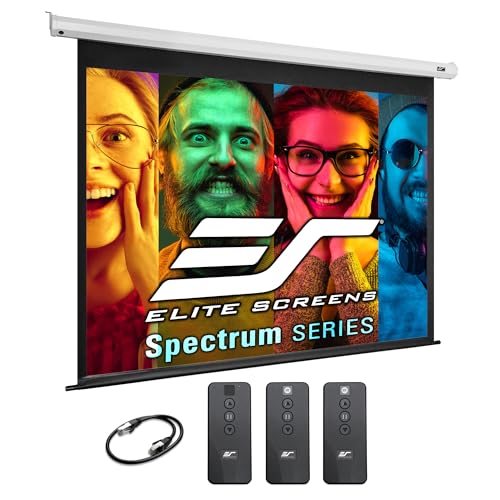
Elite Screens Spectrum 180-Inch 4:3 Motorized Screen
Best for: large-format 4:3 presentations and retro projection setups
- Diagonal Size
- 180"
- Screen Type
- Motorized
- Projector Compatibility
- Standard UHD/HD
- Aspect Ratio
- 4:3
- Screen Material
- MaxWhite 2
- Gain
- 1.1
This motorized projection screen gives you a 180-inch diagonal surface with a classic 4:3 aspect ratio. Its MaxWhite 2 fabric provides a 1.1 gain and a wide 180-degree viewing angle for standard throw projectors. You receive both infrared and radio-frequency remotes plus a wired wall box controller. It suits presentations or viewers needing a large legacy-format motorized display.
- 180-degree viewing angle with 1.1 gain MaxWhite 2 material
- Motorized deployment with programmable vertical drop position
- Includes both RF and IR remotes and a wall box controller
- Dual 12-volt trigger support via wired RJ50 port and wireless RF
- 4:3 aspect ratio causes letterboxing with standard 16:9 video content
- Heavy 55-pound case requires structural wall or ceiling mounting
- Material specification limits use to standard-throw projectors
- You need a 4:3 aspect ratio screen for legacy media or business presentations.
- You want motorized operation controlled by RF, IR, or automated 12-volt triggers.
- You have wall or ceiling space to mount a 155.4-inch wide, 55-pound unit.
- You primarily watch modern 16:9 or 2.35:1 widescreen movies.
- You use an ultra-short-throw projector instead of a standard throw unit.
Verdict: Elite Screens 180-Inch Motorized 4:3 Screen gives conference rooms and retro media setups an automated 180-inch display with versatile remote controls. It matches standard-throw setups running 4:3 aspect ratio formats across wide seating arrangements.
Specifications side by side
| Spec | Elite Screens Manual Series 150-Inch Pull-Down Screen | Silver Ticket Products 135-Inch Fixed Frame Screen | Elite Screens 300-Inch Hanging Outdoor Screen | Elite Screens Yard Master Plus 200-Inch Portable Screen | Elite Screens Aeon 180-inch Fixed Frame Screen | Akia Screens 150-Inch Motorized Projector Screen | MIGO 100" Tab-Tensioned Motorized Screen | Elite Screens Spectrum 180-Inch 4:3 Motorized Screen |
|---|---|---|---|---|---|---|---|---|
| Diagonal Size | 150" | 135" | 300" | 200" | 180" | 150" | 100" | 180" |
| Screen Type | Manual Pull Down | Fixed Frame | Portable | Portable | Fixed Frame | Motorized | Tab-Tensioned Motorized | Motorized |
| Projector Compatibility | – | Long, Short, Ultra Short Throw | – | Standard, Short Throw | Standard, Short Throw | – | Short, Ultra Short, Long Throw | Standard UHD/HD |
| Aspect Ratio | 16:9 | 16:9 | 16:9 | 16:9 | 16:9 | 16:9 | – | 4:3 |
| Screen Material | MaxWhite 2 | White Material | CineWhite UHD-B | CineWhite UHD-B | CineWhite UHD-B | MaxWhite 2 | Grey Crystal | MaxWhite 2 |
| Gain | 1.1 | 1.1 | 1.3 | 1.3 | 1.1 | 1.1 | – | 1.1 |
| Viewing Angle | 180-degree | 160° | – | 180° | 160° | 180° | 175° | 180° |
| Mounting Type | Wall Mount, Ceiling Mount | Wall Mount | Hanging | – | Wall Mount | Ceiling Mount, Wall Mount | Ceiling Mount, Wall Mount | Wall Mount, Ceiling Mount |
| Resolution | 4K UHD | 8K | – | 4K UHD | 4K UHD | 4K UHD | 4K UHD | 8K |
| Intended Use | – | – | Outdoor Use | Outdoor Use | – | – | – | – |
| Throw Ratio | – | – | – | – | Ultra Short Throw | – | – | – |
| Use | Home Theater | Home Theater | Outdoor, Indoor | Outdoor, Indoor | Home Theater | – | Home Theater, Indoor | Home Theater |
| Mounting | – | – | – | – | – | Wall Mount | Wall Mount, Ceiling Mount | – |
| Dimensions | 139 × 3.5 × 84.6 inches | 122 × 1.85 × 70.8 inches | – | 40.9 × 149 × 180 inches | 97.8 × 15.8 × 6.7 inches | – | – | – |
| Weight | 24 pounds | – | – | 68.1 pounds | 27 pounds | 33.1 pounds | 18 pounds | 55 pounds |
| Width | – | – | 265 inches | – | – | 140 inches | 93.7 inches | 155 inches |
| Height | – | – | 150 inches | – | – | 84.3 inches | 76.7 inches | 119 inches |
| Size | 150" | 16:9, 135" | 300-inch | 200-inch, 16:9 | 180-inch/ 16:9 | – | 100 inch Tab-tensioned Grey Crystal | 180-inch / 4:3 |
| Color | Black | White Material | black | Front Projection | CineWhite UHD-B | black | White Housing | White |
| Model | M150UWH2 | STR-169135 | DIY300H1 | OMS200H2PLUS | AR180WH2 | 150 inch (Black Casing) | 100 inch Tab-Tensioned-Grey | ELECTRIC180V2 |
If you want specs for portable displays, the tablet screen protector buying guide details material hardness and coating layers.
Frequently asked questions
Can you pair an ultra-short throw projector with any screen?
Ultra-short throw projectors require exceptionally flat surfaces to prevent image distortion. Models like the Elite Screens Aeon 180-inch fixed frame screen support ultra-short throw projection natively. Non-tensioned roll-up surfaces often produce visible geometric warping because steep projection angles highlight microscopic waves in hanging fabric.
What is the practical advantage of a tab-tensioned motorized screen?
A tab-tensioned motorized screen uses lateral cords to pull the surface taut when lowered. This mechanism prevents the edge curling that standard hanging roll-down screens develop over time. The MIGO 100-inch tab-tensioned motorized screen demonstrates how this design maintains a flat projection plane while preserving ceiling-retraction convenience.
When should you choose a 4:3 aspect ratio screen over a 16:9 model?
You should choose a 4:3 aspect ratio screen if you primarily project legacy video content, classic video games, or commercial slide presentations. The Elite Screens Spectrum 180-inch motorized screen uses this square-like format, matching projectors dedicated to standard-definition formats rather than widescreen modern movies and streaming media.
What mounting styles work best for outdoor projector setups?
Freestanding frames with ground support work best for open venues, while grommeted screens suit locations with structural anchors. The Elite Screens Yard Master Plus 200-inch includes dedicated ground support framework, whereas the Elite Screens 300-inch DIY Pro screen relies on existing outdoor anchor points to hang its large fabric expanse.
How does an 8K-rated screen fabric differ from standard projection material?
Screen material labeled for 8K resolution features a microscopic surface texture smoother than standard matte fabric. This ultra-fine finish, found on options like the Silver Ticket Products 135-inch fixed frame screen, prevents the fabric grain from interfering with dense pixel grids, ensuring crisp image clarity across massive displays.
How do you securely install a manual pull-down projector screen?
You mount a manual pull-down screen by securing its metal casing directly into wall studs or ceiling joists. For example, the Elite Screens Manual Series 150-inch screen weighs 24 pounds, requiring sturdy anchors to handle both the static product weight and repeated downward pulling forces as you lower the display.
See also
Prices and specifications above are read from the product page and can change without notice. Scores are out of 10, based on listed specifications and buyer feedback; nothing on this page comes from handling the product.


