As Amazon Associates, we earn from qualifying purchases. This means we may receive a small commission at no extra cost to you if you click through and make a purchase.
As an Amazon Associate we earn from qualifying purchases. Links on this page are affiliate links.
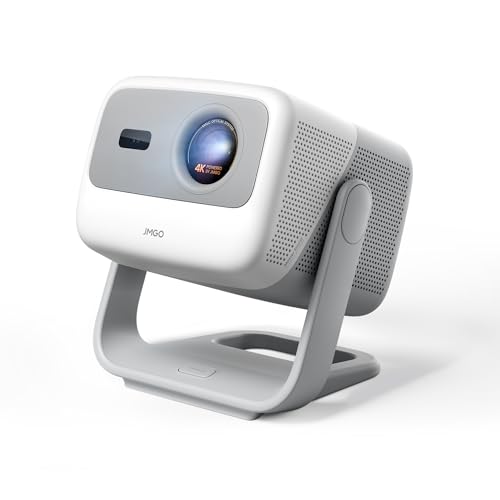
This guide examines the jmgo n1s 4k smart portable vs n1s pro true 4k projector comparison. Both models feature triple laser light engines, 4K UHD resolution, and built-in Google TV with official Netflix streaming. They also share integrated gimbal stands for rapid setup. The main distinction centers on illumination power, physical footprint, and processing hardware, with the Pro variant delivering more than double the lumens and larger internal speakers.
Brightness
1100 ISO Lumens
2250 ISO Lumens
Audio output
Dual 10W (Dolby Audio)
Dual 20W (Dolby Digital Plus)
Processor
MT9629
MT9669 (4GB RAM, 64GB storage)
Maximum screen size
200 inches
300 inches
Dimensions
6.5 x 7.3 x 7.5 inches
15.5 x 11.6 x 8.66 inches
Weight
4.4 pounds
not listed
Choose the first if
- You want a compact 4.4-pound chassis designed for mobility and travel.
- You project in dark or dimly lit spaces on displays up to 200 inches.
Choose the second if
- You need 2250 ISO lumens of brightness to handle rooms with ambient light.
- You prefer higher audio output via dual 20W speakers with 45Hz bass.
- You want a larger picture projection reaching up to 300 inches.
Verdict
The JMGO N1S 4K suits portable setups where low carry weight and smaller dimensions take priority. The JMGO N1S Pro True 4K is better suited for stationary viewing spaces that demand higher brightness, more speaker power, and larger image sizes.
JMGO N1S 4K Versus N1S Pro
Light output and brightness
Edge: JMGO N1S Pro 4K Triple Laser Projector
Light output determines how clearly you can view images in illuminated spaces. The JMGO N1S Pro 4K produces 2250 ISO lumens from its triple laser light source, which also lists a 20,000-hour lifespan. In comparison, the JMGO N1S 4K Portable delivers 1100 ISO lumens using its MALC 2.0 pure RGB triple laser engine, but its data does not specify an hourly lifespan rating. While both projectors provide 4K resolution, the JMGO N1S Pro 4K offers more than twice the light output. This extra brightness gives you clearer visibility across larger surfaces and in ambient lighting.
Build and portability
Edge: JMGO N1S 4K Portable Triple Laser Projector
If you plan to move your projector frequently, physical dimensions matter. The JMGO N1S 4K Portable is designed specifically for mobility, measuring 6.5 inches wide, 7.5 inches high, and 7.3 inches long while weighing 4.4 pounds. It also includes an EPP carrying case and offers a 127-degree vertical rotation gimbal. The JMGO N1S Pro 4K is noticeably larger, with dimensions of 15.5 inches wide, 8.66 inches high, and 11.6 inches long, while its weight is not listed. Both units include integrated gimbal stands, but the JMGO N1S 4K Portable provides a much smaller, transport-friendly footprint.
Audio format and performance
Edge: JMGO N1S Pro 4K Triple Laser Projector
Built-in speakers shape your overall listening experience without external sound systems. The JMGO N1S Pro 4K includes dual 20W speakers supported by Dolby Digital Plus, reaching down to 45Hz for deeper low-end response. The JMGO N1S 4K Portable provides dual 10W speakers equipped with standard Dolby Audio and 360-degree surround sound distribution. Both projectors process Dolby audio signals directly, but the JMGO N1S Pro 4K delivers twice the total wattage alongside upgraded Dolby Digital Plus decoding. This gives you greater acoustic volume and fuller bass depth during movie playback and casual streaming.
Smart platform and streaming
Edge: Tie
Both models share identical operating system capabilities for everyday streaming. The JMGO N1S 4K Portable and the JMGO N1S Pro 4K run Google TV, giving you direct access to over 10,000 apps and more than 800 free channels. Each device includes pre-installed, certified Netflix support, eliminating the need for external streaming sticks. You also receive voice control through Google Assistant alongside wireless casting via Google Cast or Chromecast from compatible mobile hardware. Because both projectors integrate the same smart interface, app catalog, and certified streaming services, neither model holds an advantage in platform convenience.
Gaming and processing hardware
Edge: JMGO N1S Pro 4K Triple Laser Projector
Hardware components dictate responsiveness and input performance during gaming sessions. The JMGO N1S Pro 4K carries a flagship MT9669 processor paired with 4GB of RAM and 64GB of onboard storage. Its HDMI 2.1 eARC port supports 4K 240Hz transmission, Auto Low Latency Mode, and 17ms input latency. In contrast, the JMGO N1S 4K Portable uses an MT9629 chipset with an unspecified memory capacity. While it matches the 17ms latency and includes HDMI 2.1 with MEMC, it lacks the 240Hz pass-through and ALLM support of the JMGO N1S Pro 4K.
Choosing Your JMGO Projector
Users prioritizing portability and travel
Our pick: JMGO N1S 4K Portable Triple Laser Projector
You get a lightweight 4.4-pound chassis measuring 6.5 by 7.5 by 7.3 inches, packaged with an EPP carrying case. The 127-degree vertical gimbal tilts smoothly for ceiling projection. The MALC 2.0 triple laser provides 1100 ISO lumens, 151 percent DCI-P3 coverage, and 10W dual Dolby Audio speakers for compact setups.
Viewers wanting maximum screen size
Our pick: JMGO N1S Pro 4K Triple Laser Projector
You receive an image display spanning up to 300 inches with a 1600:1 FOFO contrast ratio. Built-in setup tools include lossless zoom, screen fitting, and intelligent object avoidance. This configuration allows you to project massive visuals onto wide surfaces while the smart adjustment wizard aligns the picture to your room.
Gamers and media enthusiasts
Our pick: JMGO N1S Pro 4K Triple Laser Projector
You get dual 20W speakers running Dolby Digital Plus that deliver deep 45Hz bass without external audio gear. For high-speed entertainment, HDMI 2.1 with eARC supports 4K at 240Hz alongside Auto Low Latency Mode. Flagship MT9669 processing paired with 4GB RAM and 64GB storage maintains responsive navigation and quiet 28dB operation.

JMGO N1S 4K Portable Triple Laser Projector
Best for: portable dark-room viewing and ceiling projection
- Brightness
- 1100 ISO Lumens
- Native Resolution
- 4K UHD
- Light Source
- Triple Laser
- Smart Platform
- Google TV
- HDR Format
- HDR10
- Audio Format
- Dolby Audio
The JMGO N1S 4K is a portable triple-laser projector that delivers 4K UHD resolution and 1,100 ISO lumens of brightness. Weighing 4.4 pounds with an integrated 127-degree gimbal, it gives you quick setup on walls or ceilings without extra mounts. It suits you if you want a compact Google TV projector with wide color coverage for dark rooms.
- Triple laser light source with 110% BT.2020 color coverage
- Built-in gimbal with 127-degree vertical tilt adjustment
- Lightweight 4.4-pound chassis with included carrying case
- Integrated Google TV with native Netflix support
- 1,100 ISO lumens brightness requires controlled room lighting
- HDR format support is limited to HDR10 without Dolby Vision
- You need a lightweight 4.4-pound projector to aim at ceilings or walls using a built-in gimbal.
- You watch primarily in dim or dark spaces where 1,100 ISO lumens is sufficient.
- You want native Google TV streaming and licensed Netflix without plugging in a streaming stick.
- You plan to watch content in rooms with unshaded ambient daylight.
- You require Dolby Vision dynamic HDR processing for your media.
Verdict: JMGO N1S 4K Portable Laser Projector fits mobile viewers who need 4K resolution and vivid triple-laser color in an easily carried 4.4-pound chassis. Its 1,100 ISO lumens output makes it best suited for light-controlled spaces rather than sunlit living rooms.

JMGO N1S Pro 4K Triple Laser Projector
Best for: bright living room viewing and console gaming
- Brightness
- 2250 ISO Lumens
- Native Resolution
- 4K
- Light Source
- Triple Laser
- Smart Platform
- Google TV
- HDR Format
- HDR10
- Dimensions
- 11.6 × 15.5 × 8.66 inches
This 4K triple laser projector produces 2,250 ISO lumens and runs Google TV with native Netflix support. Its integrated gimbal provides physical tilt adjustment, while dual 20W speakers handle onboard audio. With an HDMI 2.1 port offering 17ms input latency, it suits you if you need a high-brightness display for lit spaces and console gaming without external streaming sticks.
- 2,250 ISO lumens triple laser engine for ambient light viewing
- HDMI 2.1 port with 17ms low latency and ALLM support
- Dual 20W integrated sound system with 45Hz low-frequency bass
- Built-in gimbal base for physical projection angle adjustment
- Supports HDR10 but specifications list no Dolby Vision dynamic HDR
- 1,600:1 FOFO contrast ratio limits black depth in dark scenes
- 15.5-inch width requires substantial surface space compared to compact portables
- You watch content in rooms with ambient light requiring 2,250 ISO lumens.
- You connect modern gaming consoles and need low 17ms input lag.
- You want licensed Netflix and Google TV integrated directly into the projector.
- You need an ultra-compact unit for travel rather than a 15.5-inch chassis.
- You require Dolby Vision playback for high dynamic range media.
Verdict: JMGO N1S Pro 4K Triple Laser Projector delivers high brightness and fast HDMI 2.1 response for living rooms where ambient light cannot be fully controlled.
Specifications side by side
| Spec | JMGO N1S 4K Portable Triple Laser Projector | JMGO N1S Pro 4K Triple Laser Projector |
|---|---|---|
| Brightness | 1100 ISO Lumens | 2250 ISO Lumens |
| Native Resolution | 4K UHD | 4K |
| Light Source | Triple Laser | Triple Laser |
| Smart Platform | Google TV | Google TV |
| HDR Format | HDR10 | HDR10 |
| Resolution | 4K UHD | 4K UHD |
| Audio Format | Dolby Audio | – |
| Screen Type | Portable | – |
| Dimensions | 7.3 × 6.5 × 7.5 inches | 11.6 × 15.5 × 8.66 inches |
| Weight | 4.4 pounds | – |
| Color | Off-White | – |
| Model | J70-6A6 | – |
| Size | – | Small Size |
Frequently asked questions
What are the main physical dimension differences between the JMGO N1S 4K and N1S Pro?
The JMGO N1S 4K is noticeably smaller and lighter than the N1S Pro. The standard N1S 4K measures 6.5 by 7.5 by 7.3 inches and weighs 4.4 pounds. In contrast, the N1S Pro chassis measures 15.5 by 8.66 by 11.6 inches. This makes the base model easier for you to transport.
Which projector is better suited for a bright living room?
The JMGO N1S Pro 4K fits ambient-lit living rooms better than the standard portable model. Its specifications highlight high brightness designed specifically for spaces where you cannot fully block outside light. Meanwhile, the portable N1S 4K outputs 1,100 ISO lumens, which serves light-controlled spaces best.
Do both JMGO projectors support 4K resolution and HDR?
Yes, both projectors deliver 4K UHD resolution and support HDR10 content. Whether you select the compact N1S 4K or the larger N1S Pro 4K, you receive ultra-high-definition playback powered by a triple laser engine. Both models match these core visual standards directly.
Which model is designed for console gaming?
The JMGO N1S Pro 4K is the model designed for console gaming. Its specifications highlight fast HDMI 2.1 response, which helps you maintain smooth control during fast-paced play. The portable N1S 4K focuses instead on compact travel, ceiling projection, and general dark-room entertainment.
What smart platform and audio standards does the JMGO N1S 4K include?
The JMGO N1S 4K portable projector runs on the Google TV smart platform and includes Dolby Audio support. This operating system lets you organize compatible streaming apps directly on the device. Dolby Audio decoding ensures proper soundtrack handling from internal speakers.
What is the official model number and color of the portable JMGO N1S 4K?
The JMGO N1S 4K Portable carries the model designation J70-6A6 and features an Off-White exterior finish. These specifications belong strictly to the compact 4.4-pound edition. Checking these details helps you confirm you are evaluating the portable unit rather than the larger Pro hardware.
See also
Prices and specifications above are read from the product page and can change without notice. Scores are out of 10, based on listed specifications and buyer feedback; nothing on this page comes from handling the product.


