
As Amazon Associates, we earn from qualifying purchases. This means we may receive a small commission at no extra cost to you if you click through and make a purchase.
As an Amazon Associate we earn from qualifying purchases. Links on this page are affiliate links.
HDR Formats in Modern Displays Explained
High Dynamic Range formats determine how a display processes brightness, contrast, and color data. To have the hdr format explained simply, consider how video metadata communicates with your screen to reproduce highlights and shadow details without visual clipping.
HDR signals carry digital instructions called metadata. Displays read these instructions to map incoming source content to their native panel capabilities. Spec sheets list supported standards under video features. The two primary formats in this niche are HDR10 and Dolby Vision.
HDR10 is the baseline open standard found on nearly all modern HDR displays. It uses static metadata, establishing a single brightness curve for an entire video title. Your television applies this fixed parameter across every scene, regardless of changes in scene lighting.
Dolby Vision uses proprietary dynamic metadata. It instructs your screen scene by scene or frame by frame. This real-time processing allows the display to adjust tone mapping continuously. Dark scenes retain shadow gradation, while bright scenes preserve highlight details.
Product listings identify these features directly in the specifications list as HDR Format: HDR10 or HDR Format: Dolby Vision. Displays may include one standard or decode both formats depending on their internal processor.
You care about supported formats because your hardware must match your media source. Streaming apps, game consoles, and disc players deliver specific HDR signals. When your screen decodes the matching signal, you get proper contrast tracking, full color depth, and accurate brightness levels.
Comparing Dolby Vision and HDR10 Formats
Dolby Vision
Dolby Vision delivers dynamic HDR formatting that adjusts picture instructions scene by scene. In practice, this gives you optimized highlight detail and contrast for supported movie and gaming content. It suits home theater viewers and gamers who prioritize precise visual adjustments across compatible streaming platforms. For example, the TCL 98-Inch QD-Mini LED 4K TV includes Dolby Vision alongside a 144Hz refresh rate. The trade-off is format dependency. If your source material or streaming service outputs only standard HDR10, you cannot utilize the dynamic Dolby Vision profile, meaning playback falls back to basic high dynamic range signals.
HDR10
HDR10 provides baseline high dynamic range playback across standard 4K media. In practice, it applies static metadata across an entire video title to expand color and brightness. This format suits you if you stream general content and want universal compatibility without needing specialized profiles. For instance, the Amazon Ember 55-Inch 4-Series 4K Fire TV uses HDR10 on its 4K UHD screen. The trade-off is fixed processing. Because HDR10 lacks scene-by-scene adjustments, it cannot adapt to shifting light levels in real time, giving you less highlight precision during very dark or bright scenes.
Choosing the Right HDR Format Support
Who needs it
You need full HDR format support if you regularly watch 4K streaming platforms or physical media mastered with dynamic metadata. Dolby Vision support benefits viewers who want their display to follow precise profile instructions encoded directly into the video stream. If your setup includes dedicated streaming boxes or modern gaming systems, dual support ensures your screen accepts the source signal without conversion down to basic profiles. You also benefit if you watch movies in varied room lighting. Dynamic instructions continuously manage target brightness per sequence, preserving intended specular highlights and deep shadow definitions across diverse mastered discs and streaming files. Prioritize this spec pairing if you demand direct compatibility with premium visual media feeds.
Who can skip it
You can bypass advanced HDR format support if your viewing consists mainly of cable television, broadcast sports, legacy DVDs, or standard-definition streams. These sources rely entirely on standard dynamic range specifications and cannot use HDR10 or Dolby Vision layers. Static HDR10 capabilities remain sufficient if you only watch basic HDR web videos. Instead of chasing multi-format compatibility, prioritize hardware specs like native panel contrast ratios, local dimming zones, and peak nit output. A display with high raw brightness and deep black levels renders standard content better than an underpowered screen processing advanced HDR formats.
HDR Display Terms Glossary
Peak Brightness
This measures the maximum light output your screen produces in highlights, measured in nits. A rating of 1,000 nits or higher lets your TV display vivid, realistic highlights.
Color Bit Depth
This spec defines how many color shades your TV creates. Most HDR formats require 10-bit color, giving you over one billion distinct hues to prevent visible banding in skies.
DCI-P3 Color Gamut
This standard measures the spectrum of colors your screen can display. For vibrant HDR performance, you want a TV that covers 90 percent or more of the DCI-P3 space.
Hybrid Log-Gamma
This HDR format delivers live television broadcasts. It combines standard and HDR signals into a single feed, so your TV displays enhanced dynamic range without extra metadata.
Dynamic Metadata
This data instructs your screen to adjust brightness and contrast frame by frame. Formats like Dolby Vision use it so you see tailored picture settings across every scene.
Local Dimming
This feature dims LED backlight zones independently. You need it on LCD screens for deep black levels, ensuring your HDR highlights pop without washing out dark scenes.
| # | Product | Best for | Price |
|---|---|---|---|
| 1 | Hisense 85-Inch QLED 4K Fire TV | large rooms requiring multi-format HDR streaming | |
| 2 | Amazon Ember 55-Inch 4-Series 4K Fire TV | HDR10+ streaming and Fire TV cloud gaming | |
| 3 | TCL 65-Inch 144Hz QLED 4K Fire TV | Multi-format HDR streaming and 144Hz gaming | |
| 4 | TCL 98-Inch QD-Mini LED 4K TV | large-room home theaters needing versatile HDR formats | |
| 5 | Amazon Ember 50-Inch 4K QLED Fire TV | dual dynamic HDR formats in compact rooms | |
| 6 | Amazon Ember 65-Inch 144Hz Mini-LED TV | bright-room HDR viewing and high-refresh gaming |

Hisense 85-Inch QLED 4K Fire TV
Best for: large rooms requiring multi-format HDR streaming
- HDR Format
- Dolby Vision, HDR10
- Screen Size
- 85 Inch
- Resolution
- 4K UHD
- Display Technology
- Hi-QLED
- Smart Platform
- Fire TV
- Audio Format
- Dolby Atmos
The Hisense 85-Inch QLED 4K Fire TV gives you an expansive screen equipped with broad format support. It handles Dolby Vision, HDR10+ Adaptive, HDR10, and HLG, letting you match dynamic metadata from major streaming platforms. With its 4K UHD resolution, quantum dot color, and integrated Fire TV interface, this television suits viewers who want large-format HDR content in a dedicated media room.
- Supports Dolby Vision, HDR10+ Adaptive, HDR10, and HLG formats
- 85-inch 4K UHD panel with Hi-QLED color technology
- Built-in AI light sensor adjusts screen brightness to ambient lighting
- Integrated Fire TV platform with Alexa voice navigation
- Heavy 80.2-pound chassis requires sturdy furniture or heavy-duty mounting hardware
- Deep 4-inch profile stands out further from walls than slimmer displays
- You want comprehensive HDR format playback including Dolby Vision and HDR10+ Adaptive.
- You need an extra-large 85-inch screen for a spacious viewing area.
- You prefer the built-in Fire TV operating system for streaming apps and live channels.
- You have a compact entertainment center that cannot accommodate a 74.5-inch wide frame.
- You need an ultra-thin panel for flush wall mounting.
Verdict: Hisense 85-Inch QLED 4K Fire TV delivers wide-ranging HDR format decoding and vibrant quantum-dot color for buyers outfitting a large theater space. Its automated light sensing and native Fire TV platform make it a direct match for movie watchers seeking multi-format HDR streaming without external media players.

Amazon Ember 55-Inch 4-Series 4K Fire TV
Best for: HDR10+ streaming and Fire TV cloud gaming
- HDR Format
- HDR10
- Screen Size
- 55-inch
- Resolution
- 4K Ultra HD
- Smart Platform
- Fire TV
- Audio Format
- Dolby Audio
- Dimensions
- 48.3 × 11.3 × 31.3 inches
This 55-inch Amazon Ember 4-Series television features 4K Ultra HD resolution and HDR10+ dynamic HDR decoding. It integrates Fire TV, Wi-Fi 6, and a quad-core processor to load apps and content. Dolby Audio provides standard sound decoding. You get basic high dynamic range processing and cloud gaming integration for everyday living room streaming.
- Supports HDR10 and HDR10+ dynamic metadata formats
- Wi-Fi 6 connectivity and quad-core processor
- Built-in Omnisense motion sensors wake display automatically
- Integrated Xbox Game Pass and Amazon Luna cloud gaming
- No Dolby Vision HDR format support listed
- Audio format limited to standard Dolby Audio decoding
- You stream content primarily mastered in HDR10 or HDR10+ formats.
- You want Fire TV and Wi-Fi 6 for cloud gaming via Luna or Xbox.
- You require Dolby Vision support for your 4K HDR media library.
- You need high refresh rate gaming features beyond standard specifications.
Verdict: Amazon Ember 55-Inch 4K HDR10+ Fire TV provides HDR10+ decoding, Wi-Fi 6, and Fire TV integration for viewers who stream compatible HDR media without needing Dolby Vision.

TCL 65-Inch 144Hz QLED 4K Fire TV
Best for: Multi-format HDR streaming and 144Hz gaming
- HDR Format
- Dolby Vision, HDR10
- Screen Size
- 65 Inch
- Resolution
- 4K UHD
- Display Technology
- QLED
- Refresh Rate
- 144Hz
- Smart Platform
- Fire TV
This 65-inch 4K QLED display includes wide format support across Dolby Vision, HDR10+, HDR10, and HLG. A native 144Hz refresh rate pairs with 93% DCI-P3 color space coverage and a high-brightness LED backlight. Running Fire TV with four HDMI ports, it serves viewers who switch between high-frame-rate console gaming and multi-format HDR movies in brightly lit rooms.
- Supports both Dolby Vision and HDR10+ dynamic metadata formats
- Native 144Hz refresh rate with VRR and ALLM for gaming
- Four HDMI ports including one with eARC audio return
- Built-in ambient light sensor adjusts display output to room lighting
- Uses standard LED backlighting rather than Mini-LED local dimming
- Network hardware uses Wi-Fi 5 rather than newer Wi-Fi standards
- DCI-P3 color space coverage reaches 93% rather than full coverage
- You want broad HDR compatibility across Dolby Vision, HDR10+, and HLG sources.
- You play fast-paced video games requiring a 144Hz refresh rate and VRR.
- You place your display in a room with changing light conditions.
- You require Mini-LED backlighting for deeper black levels.
- You need Wi-Fi 6 connectivity for your home network.
Verdict: TCL 65-Inch 144Hz QLED Fire TV gives gamers and movie watchers complete dynamic HDR format flexibility alongside a fast 144Hz refresh rate. It fits households that stream across multiple HDR standards and prioritize smooth motion handling.

TCL 98-Inch QD-Mini LED 4K TV
Best for: large-room home theaters needing versatile HDR formats
- HDR Format
- Dolby Vision
- Screen Size
- 98-Inch
- Resolution
- 4K
- Display Technology
- QD-Mini LED
- Refresh Rate
- 144Hz
- Smart Platform
- Fire TV
This 98-inch 4K TV combines QD-Mini LED backlighting with up to 500 local dimming zones. For HDR formats, you get full support for Dolby Vision, HDR10+, HDR10, and HLG. It features a native 144Hz refresh rate, Fire TV streaming, and an integrated Onkyo 2.1 sound system with a 20W subwoofer. It suits you if you want a massive home theater display.
- Supports Dolby Vision, HDR10+, HDR10, and HLG formats
- Native 144Hz refresh rate with Motion Rate 480
- QD-Mini LED panel with up to 500 local dimming zones
- Integrated Onkyo 2.1 audio system with 20W subwoofer
- Large 85.8-inch width requires significant space and wide furniture
- 500 local dimming zones is modest for a 98-inch panel size
- You want support for both Dolby Vision and HDR10+ dynamic formats.
- You need a native 144Hz panel for fast motion and gaming.
- You want built-in 2.1 audio without adding an immediate soundbar.
- You have limited room that cannot fit an 85.8-inch wide frame.
- You want higher local dimming zone density across a large screen.
Verdict: TCL 98-Inch QD-Mini LED 4K TV delivers broad HDR format compatibility and high refresh rates on an extra-large screen. It fits home theater setups needing full Dolby Vision and HDR10+ support without external sound hardware.
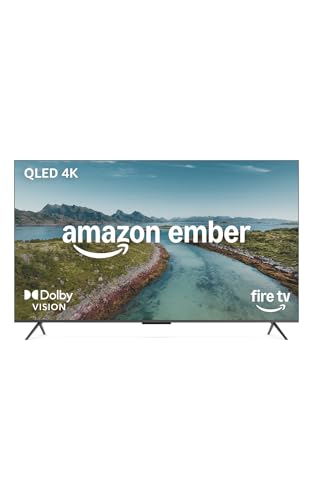
Amazon Ember 50-Inch 4K QLED Fire TV
Best for: dual dynamic HDR formats in compact rooms
- HDR Format
- Dolby Vision, HDR10
- Screen Size
- 50"
- Resolution
- 4K Ultra HD
- Display Technology
- QLED
- Smart Platform
- Fire TV
- Audio Format
- Dolby Audio
This 50-inch 4K smart television features a QLED panel paired with both Dolby Vision and HDR10+ Adaptive formats. You get dynamic HDR processing that adjusts scene lighting for your room. Built-in Fire TV software delivers cloud gaming via Amazon Luna and Xbox Game Pass, making this display suitable if you want dual HDR support in a compact room.
- Supports both Dolby Vision and HDR10+ Adaptive formats
- 4K QLED display technology
- Wi-Fi 6 connectivity with quad-core processor
- Hands-free voice control and Omnisense wake sensors
- 50-inch screen size is smaller than other options on this list
- Lacks the 144Hz refresh rate found on select alternatives
- You want both Dolby Vision and HDR10+ support on a compact screen.
- You stream games directly through Xbox Game Pass or Amazon Luna.
- You need Wi-Fi 6 connectivity for stable 4K video playback.
- You need a display larger than 50 inches for a large viewing distance.
- You want a 144Hz panel for competitive high-frame-rate gaming.
Verdict: Amazon Ember 50-Inch QLED 4K Fire TV suits viewers who want comprehensive HDR format coverage with Dolby Vision and HDR10+ Adaptive in a smaller room size. Its integrated cloud gaming services provide console-free play without extra hardware.

Amazon Ember 65-Inch 144Hz Mini-LED TV
Best for: bright-room HDR viewing and high-refresh gaming
- HDR Format
- Dolby Vision
- Screen Size
- 65-inch
- Resolution
- 4K UHD
- Display Technology
- QLED Mini-LED
- Refresh Rate
- 144Hz
- Smart Platform
- Fire TV
This 65-inch 4K QLED display pairs Mini-LED backlighting with 512 local dimming zones and up to 1,400 nits of peak brightness. For HDR playback, you get both Dolby Vision IQ and HDR10+ Adaptive to adjust contrast to ambient room light. It also includes a 144Hz refresh rate and built-in 2.1 Dolby Atmos audio.
- Dolby Vision IQ and HDR10+ Adaptive dynamic HDR support
- Mini-LED panel with 512 local dimming zones
- Peak brightness reaching up to 1,400 nits
- 144Hz refresh rate with AMD FreeSync Premium Pro
- Built-in 2.1-channel Dolby Atmos audio system
- Stand requires 14 inches of depth on your media console
- Specifications do not state the total number of HDMI ports
- You want dynamic HDR formats like Dolby Vision IQ that adjust to room lighting.
- You watch TV in bright rooms needing up to 1,400 nits of peak brightness.
- You connect gaming PCs or consoles that run up to 144Hz.
- You have a shallow media console that cannot accommodate a 14-inch depth.
- You prefer a smart operating system outside the Fire TV platform.
Verdict: Amazon Ember 65-Inch Mini-LED 4K TV suits viewers and gamers who want high-peak-brightness HDR playback with Dolby Vision IQ and 144Hz motion handling.
Specifications side by side
| Spec | Hisense 85-Inch QLED 4K Fire TV | Amazon Ember 55-Inch 4-Series 4K Fire TV | TCL 65-Inch 144Hz QLED 4K Fire TV | TCL 98-Inch QD-Mini LED 4K TV | Amazon Ember 50-Inch 4K QLED Fire TV | Amazon Ember 65-Inch 144Hz Mini-LED TV |
|---|---|---|---|---|---|---|
| Screen Size | 85 Inch | 55-inch | 65 Inch | 98-Inch | 50" | 65-inch |
| Resolution | 4K UHD | 4K Ultra HD | 4K UHD | 4K | 4K Ultra HD | 4K UHD |
| Display Technology | Hi-QLED | – | QLED | QD-Mini LED | QLED | QLED Mini-LED |
| Refresh Rate | – | – | 144Hz | 144Hz | – | 144Hz |
| HDR Format | Dolby Vision, HDR 10+ Adaptive, HLG | HDR10+ | Dolby Vision, HDR10+, HDR10, HLG | Dolby Vision, HDR10+, HDR10, HLG | Dolby Vision, HDR10+ | Dolby Vision IQ, HDR10+ Adaptive |
| Smart Platform | Fire TV | Fire TV | Fire TV | Fire TV | Fire TV | Fire TV |
| Audio Format | Dolby Atmos | Dolby Audio | Dolby Atmos, DTS Virtual:X | Dolby Atmos, DTS | Dolby Audio | Dolby Atmos |
| Intended Use | – | – | Gaming, Sports | – | – | Gaming |
| Size | 85-Inch | 55-Inch | 65-Inch | 98-Inch | 50-Inch | 65-Inch |
| Dimensions | 4 × 74.5 × 43 inches | 48.3 × 11.3 × 31.3 inches | 11.8 × 56.9 × 34.6 inches | 16.5 × 85.8 × 50.6 inches | 6.21 × 1.5 × 0.67 inches | 57 × 14 × 36.3 inches |
| Weight | 80.2 pounds | 22 pounds | 26.9 pounds | – | 1.76 ounces | 47 pounds |
| Color | Black | BLACK | – | – | BLACK | Black |
| Model | 85E6QF | 4K55N402 | 65F8D | 98QM64L | K7Q3MT | ML65F700 |
Frequently asked questions
Can a TV support both Dolby Vision and HDR10 at the same time?
Yes, many 4K televisions decode both standards on the same screen. Models such as the Hisense 85-Inch QLED and the TCL 65-Inch QLED process both Dolby Vision and HDR10 signals. Your screen automatically switches profiles to match the specific format encoded into your streaming app or connected media player.
Do you need a 144Hz refresh rate to watch HDR content?
No, high refresh rates are not required for standard HDR playback. Movies stream at lower frame rates, though displays like the TCL 65-Inch QLED and Amazon Ember 65-Inch Mini-LED pair 144Hz refresh rates with HDR formats. This combination targets fast gaming motion alongside dynamic brightness decoding.
Will an HDR10 TV play Dolby Vision video content?
Yes, an HDR10 display plays content mastered in Dolby Vision, but only as a base HDR10 signal. A television like the Amazon Ember 55-Inch 4-Series decodes the underlying HDR10 data while bypassing dynamic metadata. You still receive enhanced color and contrast, but without frame-level adjustments.
Does display panel technology affect how HDR formats look?
Yes, panel hardware directly controls how your TV displays HDR signals. Formats send brightness and color metadata, but technologies like QLED and Mini-LED dictate the light output and contrast. Models like the TCL 98-Inch QD-Mini LED utilize specialized backlights to execute the profile commands sent by dynamic formats.
Do all 6 TVs on this list include built-in smart streaming for HDR?
Yes, all 6 televisions on this list feature the Fire TV smart platform built directly into the hardware. You can access HDR10 and Dolby Vision content through native applications without connecting a separate streaming stick. This setup routes HDR metadata directly to the panel through the integrated operating system.
Can you get Dolby Vision on smaller screen sizes?
Yes, dynamic formats appear on smaller displays as well as giant home theater panels. For instance, the Amazon Ember 50-Inch QLED includes both Dolby Vision and HDR10 decoding in a compact footprint. This gives you full dynamic format support without requiring an oversized display for your viewing area.
See also
Prices and specifications above are read from the product page and can change without notice. Scores are out of 10, based on listed specifications and buyer feedback; nothing on this page comes from handling the product.


