As Amazon Associates, we earn from qualifying purchases. This means we may receive a small commission at no extra cost to you if you click through and make a purchase.
As an Amazon Associate we earn from qualifying purchases. Links on this page are affiliate links.
Evaluating an epson vs formovie projector comes down to installation style and resolution needs. Both projectors run Android TV for built-in streaming and Chromecast casting. The Epson model offers a lightweight 1080p portable build using 3-chip 3LCD technology and 3,000 lumens of brightness. In contrast, the Formovie unit is a fixed ultra short throw 4K triple-laser projector featuring Dolby Vision and integrated Bowers and Wilkins sound.
Native Resolution
1080p Full HD
4K UHD
Brightness
3,000 lumens
1800 ISO Lumens
Throw Type
Portable standard throw
Ultra Short Throw
HDR Format
not listed
Dolby Vision, HDR10+
Audio
Bass reflex speaker
Dolby Atmos, Bowers & Wilkins dual 15W
Choose the first if
- You need a lightweight 5.7-pound unit built for portable use and travel.
- You want 3,000 lumens of brightness for rooms with ambient light.
Choose the second if
- You want 4K UHD resolution paired with Dolby Vision and HDR10+ decoding.
- You require an ultra short throw laser setup placed directly beneath the projection surface.
Verdict
Choose the Epson projector if you prioritize high lumen output and convenient portability. Opt for the Formovie projector if you want a fixed ultra short throw setup with 4K resolution and advanced HDR formats. Your choice depends strictly on whether your space calls for a mobile display or a dedicated home theater installation.
Epson vs Formovie Projector Comparison
Resolution and picture clarity
Edge: Formovie Theater 4K UST Laser Projector
Resolution determines how sharp your projected image looks. The Epson EpiqVision Flex 1080p Projector delivers a native resolution of 1080p Full HD. You can project images up to 300 inches for viewing or meetings. In contrast, the Formovie Theater 4K UST Laser Projector outputs native 4K UHD clarity. This provides four times the pixel count of standard high definition. Formovie also incorporates ALPD4.0 RGB+ triple laser technology that covers 107% of the Rec.2020 color space with over 1.07 billion colors. If you want maximum fine detail and sharpness on large screens, the Formovie projector holds the advantage in display definition.
Light output and brightness
Edge: Epson EpiqVision Flex 1080p Projector
Light output affects how well your picture handles ambient room lighting. The Epson EpiqVision Flex 1080p Projector outputs 3,000 lumens of both color brightness and white brightness. It relies on a 3-chip 3LCD engine that reproduces 100% of the RGB color signal in every frame. This high rating helps you view content without dimming all your lights. Meanwhile, the Formovie Theater 4K UST Laser Projector is rated at 1800 ISO Lumens using an ALPD4.0 triple laser system. While Formovie provides consistent laser illumination, Epson delivers a higher overall lumen rating to fight brighter ambient environments.
HDR format support
Edge: Formovie Theater 4K UST Laser Projector
High dynamic range formats expand contrast and tonal depth for supported videos. The Formovie Theater 4K UST Laser Projector supports both Dolby Vision and HDR10+ decoding. It pairs this processing with a stated 3000:1 FOFO contrast ratio, letting you view enhanced shadow details and highlight gradients in modern video content. On the other hand, the Epson EpiqVision Flex 1080p Projector product data does not list any HDR format support or contrast ratio specifications. If you plan to watch mastered high dynamic range films and series, Formovie provides the dedicated decoding hardware and format compatibility you need.
Audio format and hardware
Edge: Formovie Theater 4K UST Laser Projector
Integrated speakers dictate whether you need external hardware right away. The Formovie Theater 4K UST Laser Projector features dual 15W full-range speakers custom designed and tuned by Bowers & Wilkins engineers. It also supports Dolby Atmos spatial audio processing to create a wider listening soundstage. The Epson EpiqVision Flex 1080p Projector comes equipped with a built-in bass reflex speaker suitable for basic viewing and video calls. However, Epson does not specify the speaker wattage and does not include advanced audio formats like Dolby Atmos. Formovie provides a significantly more powerful built-in sound system.
Build and physical portability
Edge: Epson EpiqVision Flex 1080p Projector
Chassis dimensions determine placement options and ease of transport. The Epson EpiqVision Flex 1080p Projector measures 12.5 inches wide, 8.3 inches long, and 3.4 inches tall, weighing 5.7 pounds. Its compact white frame easily fits into backpacks so you can carry it between home, work, or travel setups. Conversely, the Formovie Theater 4K UST Laser Projector is an ultra short throw unit measuring 22 inches long, 14 inches wide, and 5 inches high, weighing 16.5 pounds. It is built as a stationary living room hub, giving Epson the clear advantage for portable use.
Choosing Between Epson and Formovie
Travelers needing a lightweight portable display
Our pick: Epson EpiqVision Flex 1080p Projector
You get a compact 5.7-pound body sized at 12.5 by 8.3 inches that fits inside backpacks. The unit generates 3,000 lumens of color and white brightness for varied ambient lighting. An integrated bass reflex speaker and Android TV operating system support standalone streaming without requiring extra sound gear or media players.
Home theater viewers prioritizing HDR and sound
Our pick: Formovie Theater 4K UST Laser Projector
You gain native 4K UHD playback with Dolby Vision and HDR10+ format decoding. Its ALPD4.0 triple laser achieves 107% of the Rec.2020 color gamut and a 3000:1 FOFO contrast ratio. Built-in dual 15W speakers tuned by Bowers & Wilkins provide Dolby Atmos spatial audio processing right out of the cabinet.
Living room setups requiring credenza placement
Our pick: Formovie Theater 4K UST Laser Projector
You place this ultra short throw projector close against your wall, avoiding ceiling mounting or room-spanning cables. Its laser engine outputs 1800 ISO lumens for ambient light viewing. Certified Android TV 11.0 gives you native access to over 5,000 apps alongside integrated Chromecast casting from phones and tablets.

Epson EpiqVision Flex 1080p Projector
Best for: Bright, portable 1080p streaming and business presentations
- Native Resolution
- Full HD 1080p
- Display Technology
- 3-Chip 3LCD
- Smart Platform
- Android TV
- Intended Use
- Streaming
- Screen Type
- Portable
- Dimensions
- 8.3 × 12.5 × 3.4 inches
This portable projector uses 3-chip 3LCD technology to produce 3,000 lumens of both color and white brightness. It delivers a native Full HD 1080p image up to 300 inches and runs on Android TV with Chromecast built in. At 5.7 pounds, it suits you if you need a bright, easily movable display for presentations or streaming in standard rooms.
- 3,000 lumens of color and white brightness
- 3-chip 3LCD design prevents rainbow artifacts
- Built-in Android TV interface with Chromecast
- Scales up to a 300-inch image size
- Native resolution caps at Full HD 1080p instead of 4K
- Standard throw setup requires dedicated distance from the projection surface
- You want a 5.7-pound projector that fits into a backpack for travel.
- You need 3,000 lumens of brightness to handle rooms with ambient light.
- You prefer built-in Android TV streaming without attaching external media sticks.
- You require native 4K resolution for maximum image sharpness.
- You need an ultra-short-throw unit that sits directly against the wall.
Verdict: Epson EpiqVision Flex 1080p Portable Projector suits users seeking a 3,000-lumen 1080p display that travels easily between work presentations and home entertainment.

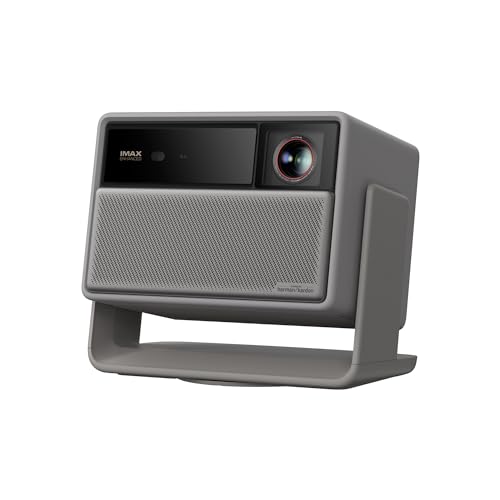
Formovie Theater 4K UST Laser Projector
Best for: dedicated 4K ultra short throw home theaters
- Brightness
- 1800 ISO Lumens
- Native Resolution
- 4K UHD
- Light Source
- Triple Laser
- Throw Type
- Ultra Short Throw
- Smart Platform
- Android TV 11.0
- HDR Format
- Dolby Vision, HDR10+
The Formovie Theater is an ultra short throw projector built for home cinema setups. It delivers native 4K UHD resolution using an ALPD 4.0 triple-laser light source rated at 1,800 ISO lumens. With built-in Dolby Vision, HDR10+, and integrated Bowers & Wilkins speakers, it suits you if you want a dedicated living-room display without long projection distances.
- Native 4K UHD projection with Dolby Vision and HDR10+ decoding
- ALPD 4.0 triple laser covering 107% of the Rec.2020 color gamut
- Built-in 30W Bowers & Wilkins speaker system with Dolby Atmos
- Certified Android TV 11.0 with Chromecast built-in
- Chassis weighs 16.5 pounds and measures 22 inches wide, limiting mobility
- Peak brightness of 1,800 ISO lumens requires controlled ambient light
- You want 4K projection placed inches from your wall or screen.
- You prioritize color depth with wide Rec.2020 coverage and Dolby Vision.
- You prefer an all-in-one setup with integrated high-output sound.
- You need a lightweight portable projector to move between rooms.
- You plan to watch content in spaces with unmanaged daytime sunlight.
Verdict: Formovie Theater 4K UST Laser Projector fits home theater builders who want a fixed-position setup featuring high color coverage, Dolby Vision decoding, and built-in premium audio.
Specifications side by side
| Spec | Epson EpiqVision Flex 1080p Projector | Formovie Theater 4K UST Laser Projector |
|---|---|---|
| Brightness | – | 1800 ISO Lumens |
| Native Resolution | Full HD 1080p | 4K UHD |
| Light Source | – | Triple Laser |
| Display Technology | 3-Chip 3LCD | – |
| Throw Type | – | Ultra Short Throw |
| Smart Platform | Android TV | Android TV 11.0 |
| HDR Format | – | Dolby Vision, HDR10+ |
| Resolution | 1080p Full HD | 4K UHD |
| Intended Use | Streaming | – |
| Throw Ratio | – | Ultra Short Throw |
| Operating System | Android TV | – |
| Screen Type | Portable | – |
| Dimensions | 8.3 × 12.5 × 3.4 inches | 22 × 14 × 5 inches |
| Weight | 5.7 pounds | 16.5 pounds |
| Color | White | Cosmos Grey |
| Model | V11HA85020-N | FORMOVIE-THEATER |
Frequently asked questions
How do the installation requirements differ between these Epson and Formovie models?
The Formovie Theater uses an ultra short throw design, letting you place it inches from your projection surface. The Epson EpiqVision Flex is a standard portable unit that requires more throw distance across the room. Your room layout dictates placement, making Formovie suitable for tight spaces near walls.
What light source technology does each projector use?
The Formovie Theater utilizes a solid-state laser light source for illumination. Epson features a 3LCD display system engineered to produce balanced color output. Laser systems generally provide rapid startup times and consistent brightness throughout their operational life, while 3LCD chips eliminate color wheel artifacts during video playback.
Does the Epson or Formovie projector support Dolby Vision?
Only the Formovie Theater includes dedicated Dolby Vision HDR decoding. The Epson EpiqVision Flex focuses on standard 1080p Full HD playback without dynamic Dolby Vision processing. If you watch compatible streaming content mastered in Dolby Vision, the Formovie hardware automatically optimizes frame-by-frame tone mapping for your display.
Which projector is easier to move between different rooms?
The Epson EpiqVision Flex is designed for easy transport, weighing just 5.7 pounds in a compact white chassis. In comparison, the Formovie Theater weighs 16.5 pounds and measures 22 inches long. You can easily slip the Epson model into a bag for travel, whereas Formovie serves stationary setups.
How does the display resolution compare between Epson and Formovie?
Formovie provides a native 4K UHD resolution, outputting four times the pixel density of standard high-definition signals. The Epson EpiqVision Flex projects in native 1080p Full HD. You get crisper image edges and finer surface textures on large projections when viewing high-resolution sources through the 4K Formovie unit.
What smart operating system runs on these projectors?
The Epson EpiqVision Flex comes equipped with Android TV for integrated app access and content navigation. Formovie focuses on home theater installations with built-in decoding features. Running an integrated operating system lets you access streaming services directly over your local Wi-Fi connection without wiring an external streaming stick.
See also
Prices and specifications above are read from the product page and can change without notice. Scores are out of 10, based on listed specifications and buyer feedback; nothing on this page comes from handling the product.