
As Amazon Associates, we earn from qualifying purchases. This means we may receive a small commission at no extra cost to you if you click through and make a purchase.
As an Amazon Associate we earn from qualifying purchases. Links on this page are affiliate links.
When choosing between a 1080p Full HD vs WXGA projector, you compare two distinct display targets. Both units deliver bright projection for presentations and video in compact white designs. The core difference lies in image detail and brightness. The Full HD 1080p unit focuses on higher visual clarity with built-in Android TV streaming, while the WXGA model emphasizes higher 4,000 ANSI lumens output and a 120Hz refresh rate.
Native resolution
Full HD 1080p
WXGA (1280x800p)
Display technology
3-Chip 3LCD
DLP
Brightness
3,000 lumens
4,000 ANSI lumens
Smart platform
Android TV
Not listed
Refresh rate
Not listed
120Hz
Choose the first if
- You want native Full HD 1080p resolution for streaming media and virtual meetings.
- You need an integrated Android TV platform with Google Assistant voice search and built-in Chromecast.
Choose the second if
- You need 4,000 ANSI lumens of brightness to overcome ambient light in meeting rooms or classrooms.
- You require a 120Hz refresh rate and 16ms input latency for fast-paced action.
Verdict
Choose the Epson 1080p projector if you prioritize sharper resolution, 3LCD color reproduction, and built-in streaming apps. Select the ViewSonic WXGA model if you need 4,000 ANSI lumens for lit spaces and high-refresh-rate projection.
1080p Full HD vs WXGA Comparison
Resolution and Display Detail
Edge: Epson EpiqVision Flex 1080p Projector
The Epson EpiqVision Flex 1080p Projector delivers Full HD 1080p native resolution. In comparison, the ViewSonic WXGA 4000-Lumen DLP Projector outputs WXGA resolution at 1280×800 pixels. The 1080p format provides more vertical and horizontal pixels, which sharpens fine lines, spreadsheet numbers, and high-definition video. Epson also supports image sizes up to 300 inches, whereas ViewSonic lists image sizes between 80 and 150 inches. If you want finer visual definition and larger maximum screen coverage, the Epson projector holds the advantage in pixel density and display scale.
Brightness and Ambient Light Performance
Edge: ViewSonic WXGA 4000-Lumen DLP Projector
The ViewSonic WXGA 4000-Lumen DLP Projector produces 4,000 ANSI lumens using its lamp light source. The Epson EpiqVision Flex 1080p Projector provides 3,000 lumens of color and white brightness. That extra 1,000 lumens gives ViewSonic an advantage when you run presentations in rooms with moderate ambient light, such as meeting rooms or open classrooms. Epson ensures equal color and white output with its 3LCD system, but ViewSonic delivers more raw brightness to prevent washed-out text under overhead lighting. For brightly lit environments, ViewSonic takes the lead.
Display Technology and Color Reproduction
Edge: Epson EpiqVision Flex 1080p Projector
The Epson EpiqVision Flex 1080p Projector utilizes a 3-chip 3LCD display engine. This system displays 100 percent of the RGB color signal for every frame, preventing the rainbowing artifacts common to single-chip systems. The ViewSonic WXGA 4000-Lumen DLP Projector uses DLP technology along with proprietary SuperColor technology for a wide color gamut. While ViewSonic focuses on lifelike visuals for business and education tasks, DLP hardware can produce color breakup in high-contrast scenes. Epson maintains consistent color accuracy and artifact-free viewing across all projected content.
Refresh Rate and Motion Response
Edge: ViewSonic WXGA 4000-Lumen DLP Projector
The ViewSonic WXGA 4000-Lumen DLP Projector features a 120Hz refresh rate and a low 16ms input latency. These numbers mean you get faster frame transitions and minimal input delay during dynamic presentations or fast video feeds. The Epson EpiqVision Flex 1080p Projector does not publish an input lag rating or high refresh rate in its specifications. If your usage involves fast-moving content where latency matters, ViewSonic gives you verifiable motion specs. Because Epson leaves these gaming and latency metrics unlisted, ViewSonic wins on motion response.
Smart Platform and Streaming Features
Edge: Epson EpiqVision Flex 1080p Projector
The Epson EpiqVision Flex 1080p Projector includes an Android TV smart platform. It comes with built-in Chromecast and a voice remote running Google Assistant, giving you native access to Netflix, Hulu, Disney+, and YouTube. The ViewSonic WXGA 4000-Lumen DLP Projector includes no onboard operating system, smart streaming apps, or wireless casting tools. You must connect an external laptop or media streamer via HDMI to supply video content to ViewSonic. For self-contained streaming and direct wireless casting from mobile devices, Epson delivers complete independent functionality.
Installation and Physical Setup
Edge: ViewSonic WXGA 4000-Lumen DLP Projector
The ViewSonic WXGA 4000-Lumen DLP Projector offers a 1.1x optical zoom, vertical keystone correction, and dedicated ceiling mount support. It projects a 100-inch diagonal image from 11 feet away with a 1.5 to 1.7 throw ratio. The Epson EpiqVision Flex 1080p Projector focuses on portable use at 5.7 pounds, but its specifications do not list optical zoom or ceiling mounting options. ViewSonic weighs slightly less at 4.85 pounds and includes hardware alignment tools for fixed conference room installations. ViewSonic provides superior setup adjustability for permanent mount positions.
Choosing the Right Projector for You
Users who stream shows wirelessly without external devices
Our pick: Epson EpiqVision Flex 1080p Projector
You get integrated Android TV with Google Assistant voice search and built-in apps like Netflix. The system includes wireless Chromecast support for your phone or tablet. Its 3-chip 3LCD hardware prevents rainbow artifacts while the integrated bass reflex speaker provides audio without extra hardware on up to 300-inch projections.
Presenters setting up in moderate ambient room lighting
Our pick: ViewSonic WXGA 4000-Lumen DLP Projector
You get 4,000 ANSI lumens from a lamp light source to keep presentations readable in illuminated classrooms or workspaces. The unit supports ceiling mounting alongside 1.1x optical zoom and vertical keystone correction. These physical adjustment tools help you align an 80 to 150-inch image onto your screen quickly.
Viewers who prioritize fluid motion and low latency
Our pick: ViewSonic WXGA 4000-Lumen DLP Projector
You benefit from a 120Hz refresh rate combined with a 16ms input latency for responsive frame changes. SuperColor DLP technology handles your color reproduction across screen sizes up to 150 inches. At 4.85 pounds, this projector also weighs less if you need to transport it between rooms.
| # | Product | Best for | Price |
|---|---|---|---|
| 1 | Epson EpiqVision Flex 1080p Projector | Full HD video and built-in smart streaming | |
| 2 | ViewSonic WXGA 4000-Lumen DLP Projector | bright classrooms and presentation spaces |

Epson EpiqVision Flex 1080p Projector
Best for: Full HD video and built-in smart streaming
- Resolution
- 1080p Full HD
- Native Resolution
- Full HD 1080p
- Display Technology
- 3-Chip 3LCD
- Smart Platform
- Android TV
- Intended Use
- Streaming
- Screen Type
- Portable
The Epson EpiqVision Flex provides native 1080p Full HD resolution using 3-chip 3LCD display technology. It outputs 3,000 lumens of color and white brightness and projects images up to 300 inches. With integrated Android TV and built-in Chromecast, you get direct access to streaming platforms. It suits you if you need sharp 1080p video and integrated streaming.
- Native 1080p Full HD resolution
- 3-chip 3LCD display technology
- 3,000 lumens of color and white brightness
- Integrated Android TV with voice remote and Chromecast
- 3,000-lumen output is lower than 4,000-lumen alternatives on the list
- Weighs 5.7 pounds, requiring more pack space than pocket-sized units
- You prioritize native 1080p Full HD clarity over lower WXGA resolution.
- You want built-in Android TV streaming without attaching external dongles.
- You need matched 3,000-lumen color and white brightness via 3LCD technology.
- You need 4,000 lumens of brightness to combat high ambient daylight.
- You require an ultra-light projector under 5 pounds for daily transit.
Verdict: Epson EpiqVision Flex 1080p 3LCD Projector delivers sharp Full HD playback with integrated Android TV apps for viewers who want higher resolution than WXGA alternatives.
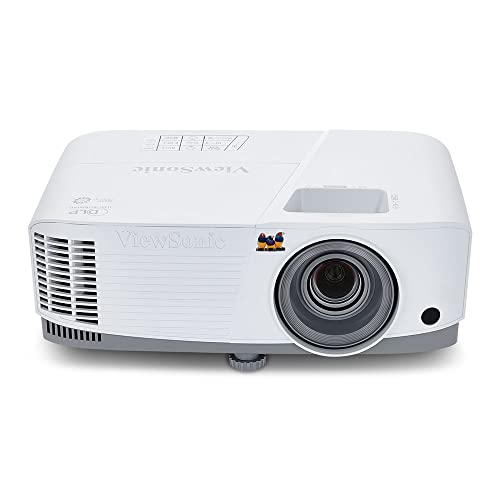
ViewSonic WXGA 4000-Lumen DLP Projector
Best for: bright classrooms and presentation spaces
- Resolution
- WXGA
- Brightness
- 4,000 ANSI lumens
- Native Resolution
- WXGA (1280x800p)
- Light Source
- Lamp
- Display Technology
- DLP
- Refresh Rate
- 120Hz
This DLP projector delivers a native WXGA resolution of 1280×800 pixels with a 4,000 ANSI lumen lamp light source. It pairs a 120Hz refresh rate and 16ms input latency with a 1.1x optical zoom lens. It suits you if you need high brightness for presentations or fast video in spaces with moderate ambient light.
- 4,000 ANSI lumens handles moderate ambient light
- 120Hz refresh rate and 16ms input latency
- Projects 80 to 150-inch image sizes
- Includes 1.1x optical zoom and vertical keystone correction
- Native WXGA (1280×800) resolution provides lower detail than 1080p
- Uses a conventional lamp rather than a solid-state light source
- Optical zoom adjustment is limited to 1.1x
- You need 4,000 ANSI lumens of brightness for rooms with ambient light.
- You want a fast 120Hz refresh rate paired with 16ms input latency.
- You project widescreen presentations at native 1280×800 resolution.
- You require native 1080p Full HD resolution for detailed content.
- You need wider optical zoom than 1.1x for throw distance flexibility.
Verdict: ViewSonic WXGA 4000-Lumen DLP Projector fits presenters who prioritize 4,000 ANSI lumen visibility and a 120Hz refresh rate over 1080p pixel density.
Specifications side by side
| Spec | Epson EpiqVision Flex 1080p Projector | ViewSonic WXGA 4000-Lumen DLP Projector |
|---|---|---|
| Brightness | – | 4,000 ANSI lumens |
| Native Resolution | Full HD 1080p | WXGA (1280x800p) |
| Light Source | – | Lamp |
| Display Technology | 3-Chip 3LCD | DLP |
| Smart Platform | Android TV | – |
| Resolution | 1080p Full HD | WXGA |
| Refresh Rate | – | 120Hz |
| Intended Use | Streaming | – |
| Operating System | Android TV | – |
| Use | – | Business |
| Screen Type | Portable | – |
| Mounting | – | Ceiling Mount |
| Dimensions | 8.3 × 12.5 × 3.4 inches | 4.33 × 11.6 × 8.58 inches |
| Weight | 5.7 pounds | 4.85 pounds |
| Color | White | White |
| Model | V11HA85020-N | PA503W |
| Size | – | 4.3" x 8.6" x 11.6" |
Frequently asked questions
What is the main difference between 1080p and WXGA projectors?
The main difference is display resolution and pixel structure. A 1080p projector produces a sharper 1920×1080 image suited for video streaming, while WXGA runs at a lower 1280×800 format. The Epson EpiqVision Flex offers 1080p Full HD clarity, whereas the ViewSonic PA503W operates with native WXGA output for business tasks.
Which resolution works best for watching movies and streaming shows?
Full HD 1080p works best because standard modern video streams match this resolution natively. You avoid downscaling or letterboxing artifacts common with 16:10 WXGA displays. For home media setups, the Epson EpiqVision Flex pairs this 1080p native resolution with built-in Android TV software, making it dedicated for media playback.
Does a WXGA projector offer any advantages over a 1080p model?
WXGA models often provide higher light output and specialized hardware specs for office or classroom settings. For instance, the ViewSonic PA503W supplies a high 4,000-lumen DLP projection system and a rapid 120Hz refresh rate. These features help you present data clearly across well-lit rooms where absolute resolution is secondary.
What is the difference between 3LCD and DLP projection technologies?
The two display technologies handle color projection and light path differently. A 3LCD system, seen on the Epson EpiqVision Flex, splits light across three dedicated LCD chips for steady color balance. In contrast, the DLP design on the ViewSonic PA503W uses micromirrors to reflect light, enabling high brightness and 120Hz capability.
How does projector portability compare between these display options?
Physical portability depends on projector dimensions, weight, and mounting options rather than resolution alone. The Epson EpiqVision Flex weighs 5.7 pounds with a portable screen classification, while the ViewSonic PA503W weighs 4.85 pounds and supports ceiling mounting. You can move either unit between rooms, but their intended mounting structures differ.
Can you display computer presentations on both 1080p and WXGA projectors?
Yes, both display resolutions accept standard computer inputs. A WXGA unit projects a native 16:10 aspect ratio, which matches many older laptop screens and document layouts. A 1080p unit displays in 16:9 widescreen, giving you extra horizontal room for modern slides and media without black bars around widescreen content.
See also
Prices and specifications above are read from the product page and can change without notice. Scores are out of 10, based on listed specifications and buyer feedback; nothing on this page comes from handling the product.


